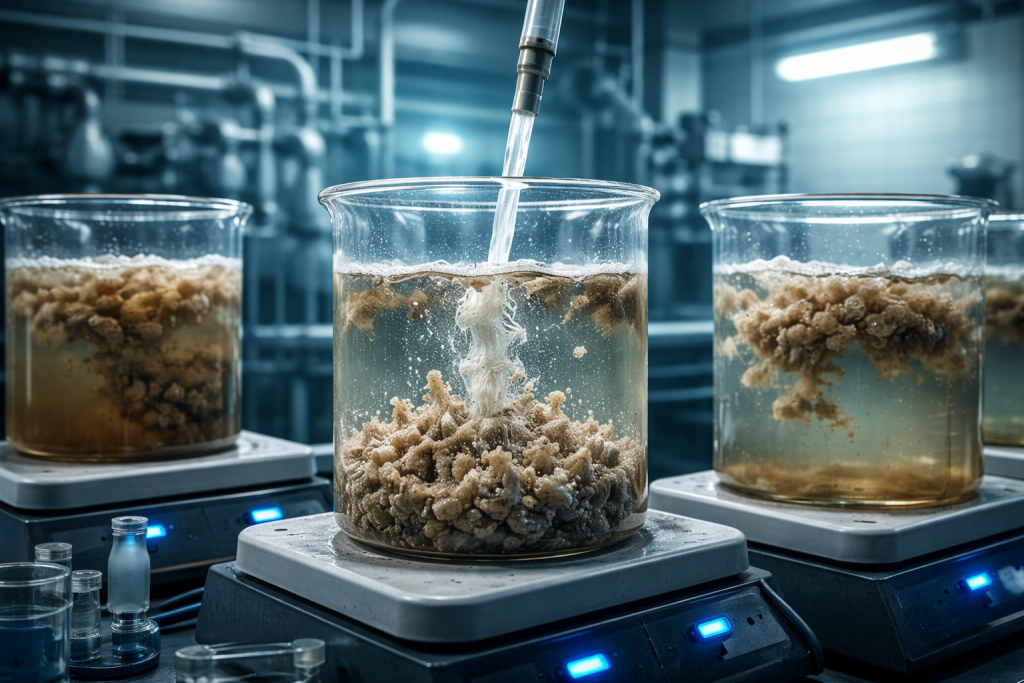
Polymers are essential to modern wastewater treatment, yet they are often the least understood chemical in the plant. Operators know when a polymer is working—cake dryness, centrate clarity, thickener performance—but the reason one polymer outperforms another is usually rooted in how and where it is used, not in brand loyalty. Two cationic polymers commonly encountered in municipal systems are Zetag® 8812S and PCEN-60. Both work. They solve different operational priorities.
01 — What Cationic Polymers Actually DoThe Foundation: Charge Neutralization and Floc Formation
Most wastewater solids carry a negative surface charge, which keeps particles dispersed and suspended in water. This is a problem for clarifiers and dewatering equipment—you can't separate what won't settle or thicken.
Cationic polymers work by:
- Neutralizing that negative surface charge on solids particles
- Acting as bridges that link particles together
- Forming larger, stronger floc that settles or dewaters efficiently
Important distinction: Polymers are not coagulants (like alum or PACL). They arrive late in the process, after solids already exist. They don't create floc—they improve it. Confusing these roles leads to misapplied chemistry and wasted treatment steps.
Polymers are used for three primary functions: sludge thickening, sludge conditioning (before dewatering), and improving mechanical dewatering performance. Which polymer you choose depends on which of these is your operational bottleneck.
02 — Zetag® 8812SHigh-Performance Mechanical Dewatering Polymer
Zetag® 8812S is a high-molecular-weight cationic emulsion polymer engineered specifically for mechanical sludge dewatering. It is the choice for plants operating belt filter presses, centrifuges, or screw presses where the primary goal is maximum water removal and stable, high-solids sludge cake.
Why Zetag 8812S is chosen:
- Very strong floc formation that survives high-shear mechanical equipment
- Superior floc bridging and structure—particles hold together even under centrifugal force
- Excellent centrate clarity (reduced suspended solids in the return stream)
- Produces drier cake, directly reducing hauling and disposal costs
Operational reality: Zetag 8812S is more sensitive to dose than other polymers. Get it right and you see immediate improvement in cake dryness and centrate clarity. Overdose or underdose and performance drops noticeably. This requires operator attention and periodic jar testing to dial in the optimal dose.
Plants choose this polymer when mechanical dewatering performance is the bottleneck and cake solids directly affect the economics of the plant (trucking costs, disposal fees, land application logistics).
03 — PCEN-60Reliable, Forgiving Large-Scale Conditioning Polymer
PCEN-60 is also a cationic emulsion polymer, but it is specified for a different operational context: continuous, high-volume municipal plants where consistency and cost control matter as much as peak performance.
Common uses include:
- Primary or waste activated sludge conditioning before centrifuge or belt press
- Clarifier or lagoon solids enhancement to improve settling rates
- Feeding dewatering systems where sludge quality varies day to day (age, loading, temperature)
Why PCEN-60 is chosen:
- More forgiving to dose changes and sludge variability
- Stable performance across changing operating conditions
- Predictable cost per ton of dry solids
- Well-suited to plants with steady, high-volume polymer demand
Operational reality: PCEN-60 doesn't demand the same level of tuning as Zetag 8812S. A dose range works consistently. Sludge age changes, temperature varies, loading fluctuates—and PCEN-60 performs reliably within a reasonable operating window. This is valuable in large plants where operational stability and labor efficiency matter.
Plants choose this polymer when steady, predictable solids handling matters more than extracting every 1–2% of additional cake dryness.
04 — The Practical DifferencePerformance vs. Consistency—Choose Your Priority
Zetag® 8812S = Optimized for peak dewatering performance at the mechanical equipment. Requires dose tuning. Produces drier cake. Requires operator attention.
PCEN-60 = Optimized for reliable, continuous solids conditioning across the treatment plant. Forgiving to dose variations. Produces good results consistently. Lower operational touch required.
Both are effective cationic polymers. They are optimized for different objectives. Choosing the wrong one for your plant's priority is a common, expensive mistake.
05 — Side-by-Side ComparisonTechnical and Operational Differences
| Feature | Zetag® 8812S | PCEN-60 |
|---|---|---|
| Polymer type | Cationic | Cationic |
| Physical form | Emulsion (liquid) | Emulsion (liquid) |
| Primary role | Mechanical dewatering | Sludge conditioning |
| Typical application point | At belt press or centrifuge inlet | Upstream of dewatering equipment or in clarifiers |
| Molecular weight | High | Medium–High |
| Charge density | Moderate–High | Moderate |
| Floc strength | Very strong (survives high shear) | Strong (good at moderate shear) |
| Shear resistance | High (designed for centrifuges) | Moderate (suitable for most systems) |
| Dose sensitivity | Higher (requires tuning and jar tests) | Lower (more forgiving to variations) |
| Cake solids typical | 35–42% (very dry) | 30–36% (good dryness) |
| Centrate clarity | Excellent (<100 mg/L TSS) | Good (100–200 mg/L TSS) |
| Dose tolerance window | Narrow (±10%) | Wide (±20%) |
| Best suited for | Centrifuges, belt presses (high-shear equipment) | Large municipal systems with variable sludge quality |
| Operational focus | Maximum cake dryness and centrate clarity | Consistent solids handling and cost control |
06 — How Plants ChooseMatch the Polymer to Your Operational Bottleneck
Choose Zetag® 8812S When:
- Mechanical dewatering performance is your top priority
- Cake dryness directly affects hauling costs (20+ mile hauls, long-term storage, or disposal fees)
- Centrate clarity is critical (return to headworks creates problems if high in TSS)
- Operators can commit to dose tuning and periodic jar testing
- The plant operates centrifuges or belt presses under high shear conditions
Choose PCEN-60 When:
- Polymer is fed continuously at high volumes (>50 gpd typical)
- Sludge characteristics vary significantly day to day (age, temperature, loading)
- Cost predictability matters more than extracting maximum cake dryness
- The plant values operational stability and low maintenance over peak performance
- Operators prefer a chemistry that is forgiving to variations
Critical Reminder: Polymer Performance Is Site-Specific
Two plants with identical belt presses can require different polymers due to differences in sludge age, temperature, upstream chemistry (alum vs. PACL vs. iron salts), and biological solids. Bench testing and jar trials matter more than brand names alone. A polymer that works at Plant A may not be optimal at Plant B. Always conduct jar tests before switching polymers or changing dose significantly.
07 — Operational TakeawayThese Are Tools for Different Jobs, Not Competing Versions of the Same Product
Zetag® 8812S and PCEN-60 are not competitors. They are tools optimized for different operational objectives:
- Zetag® 8812S excels at high-performance mechanical dewatering. Choose it when maximum cake dryness and centrate clarity are your operational priorities.
- PCEN-60 excels at consistent, large-scale sludge conditioning. Choose it when reliability and cost predictability matter more than extracting every 1–2% additional cake dryness.
Know what your plant is optimizing for. Run jar tests to dial in the optimal dose. Commit to the same polymer and dose for at least 90 days before making changes. Measure the results: cake solids, centrate clarity, throughput, chemical cost per ton of dry solids. Then optimize.