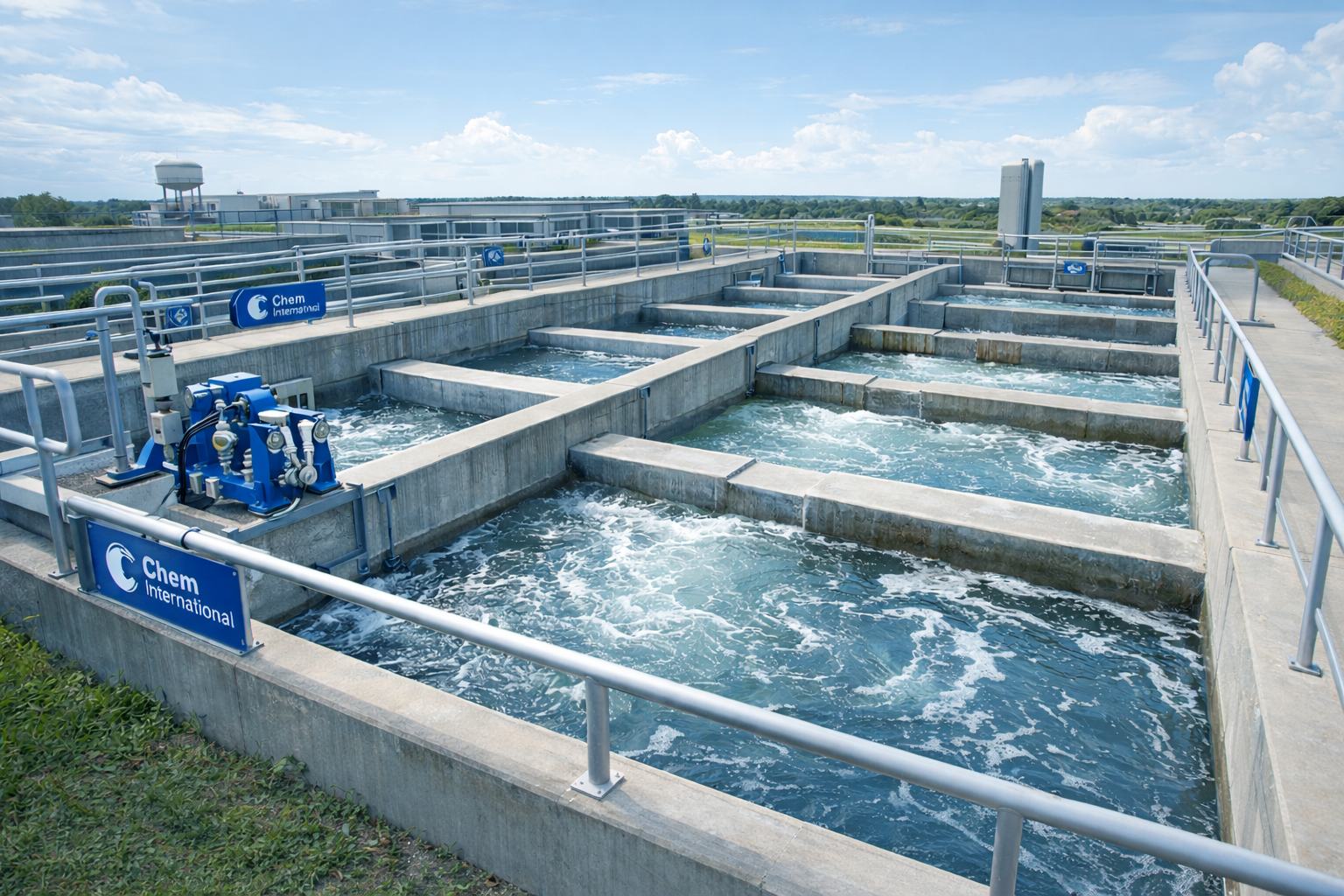
Polymers are everywhere in wastewater treatment, yet they remain among the most misunderstood chemicals in the plant. Ask two operators which polymer they swear by and you'll likely get two different answers — both of them correct, for their specific situation.
What Cationic Polymers Actually Do
Most wastewater solids carry a negative surface charge that keeps particles dispersed and resistant to separation. Cationic polymers neutralize that charge, bridge particles into larger clusters, and build floc strong enough to survive mechanical stress in dewatering equipment.
Key Point: Not All Solids Treatment is the Same
Polymers are used for sludge thickening, conditioning, and mechanical dewatering — not primary treatment and not disinfection. They work downstream, once solids already exist and need efficient separation.
Important distinction: Polymers are not coagulants. Alum and PACL do a different job upstream. Don't conflate the two.
Meet the Two Polymers
Zetag® 8812S
High-MW cationic emulsion engineered for the sharp end of the dewatering process. Built for mechanical equipment where floc needs to hold together under real shear forces.
Common Equipment- Belt filter presses
- Centrifuges
- Screw presses
Objective: Maximize water removal and produce the driest, most stable sludge cake possible.
PCEN-60
Medium-high MW cationic emulsion specified for continuous, high-volume applications where sludge characteristics shift and operational consistency matters more than peak performance.
Common Applications- Primary or WAS conditioning
- Clarifier and lagoon solids
- Variable-quality sludge feeds
Objective: Stable, predictable solids conditioning across changing operating conditions, with manageable lifecycle costs.
In operator terms: Zetag® 8812S is selected for performance at the dewatering machine. PCEN-60 is selected for reliability across the treatment plant.
Both are effective. Neither is universally superior. The question is: what is your plant trying to optimize for?
Side-by-Side Comparison
| Feature | Zetag® 8812S | PCEN-60 |
|---|---|---|
| Primary role | Sludge dewatering | Sludge conditioning |
| Application point | At belt press / centrifuge | Upstream of dewatering |
| Molecular weight | High | Medium–High |
| Floc strength | Very strong | Strong |
| Shear resistance | High | Moderate |
| Dose sensitivity | Higher — needs tuning | More forgiving |
| Best suited for | Mechanical dewatering | Continuous municipal systems |
| Operational focus | Maximum cake solids | Consistency and cost |
How to Choose: The Decision Framework
Performance Priority
- Mechanical dewatering performance is the top priority
- Cake dryness directly drives hauling or disposal costs
- Operators can fine-tune polymer dose
- Centrate clarity is a compliance concern
Reliability Priority
- Polymer is fed continuously at high volumes
- Sludge characteristics vary significantly day to day
- Cost predictability and budget stability matter
- Operational stability is valued over peak output
The Caveat Every Operator Should Hear
Polymer performance is site-specific. Two plants with identical equipment can require completely different polymers — because sludge age and biology, mixing energy, water temperature, and upstream chemistry (alum vs. PACL, iron salts, and more) all shift how polymers behave. Bench testing and jar trials should always inform your final selection, not brand names alone.
The Bottom Line
Zetag® 8812S and PCEN-60 are not competing versions of the same product. They are tools optimized for different jobs in a wastewater plant.
Zetag® 8812S excels at high-performance mechanical dewatering — when you need maximum cake solids and the operating discipline to dial in a sensitive polymer.
PCEN-60 excels at large-scale, continuous sludge conditioning — when consistency, cost control, and tolerance to variability matter most.
Choosing correctly means better solids capture, lower hauling costs, and fewer headaches for your operators. That's the point of getting this decision right.