In municipal water and wastewater treatment, disinfection and oxidation are routinely confused as the same function. They are not. Sodium hypochlorite, CAIROX® (potassium permanganate), and peracetic acid are not competitors—they are tools with distinct jobs at different points in the treatment train. Choosing wrong creates operational inefficiency, unnecessary chemical cost, or worse, a treatment failure that goes unnoticed.
01 — The Essential DistinctionDisinfection and Oxidation Are Not the Same Thing
Disinfection means inactivating microorganisms to protect public health. It kills pathogens—bacteria, viruses, protozoa—so treated water is safe to drink or discharge.
Oxidation means chemically transforming contaminants—iron, manganese, hydrogen sulfide, taste-and-odour compounds—into forms that are easier to remove by clarification or filtration. It improves treatability, not safety.
Some chemicals can do both, but operators typically choose them for one primary purpose. Confusing the two leads to misapplied chemistry and wasted treatment steps.
02 — Sodium HypochloriteThe Safe Alternative to Chlorine Gas, Standard Disinfectant
Sodium hypochlorite is a liquid solution of chlorine, typically supplied at 10–15% strength for municipal use. When added to water, it forms hypochlorous acid (HOCl)—the identical disinfecting species produced by chlorine gas, minus the handling hazards.
Critical point: Sodium hypochlorite and chlorine gas produce the same disinfectant in water, but they are worlds apart on safety and logistics. Hypochlorite is stored as a liquid under atmospheric pressure, not as a compressed gas. If released, it doesn't create a toxic cloud. Regulators accept it as a direct chlorine gas replacement. Suppliers will handle it where they refuse chlorine gas entirely due to liability.
Key characteristics:
- Provides a persistent chlorine residual (0.2–0.5 ppm typical in distribution systems)
- Moderate cold-water performance (slower disinfection in winter)
- Can form disinfection byproducts (DBPs) if organic matter is present
- Simple to apply, widely understood by operators
Use sodium hypochlorite when you need a chlorine residual for distribution system protection, or when you're replacing a chlorine gas system with an equivalent disinfectant.
03 — Potassium Permanganate (CAIROX®)Pretreatment Oxidizer, Not a Disinfectant
Potassium permanganate (KMnO₄) is a strong oxidizer sold commercially under the trade name CAIROX®. It is not a primary disinfectant. Its role is upstream pretreatment—oxidizing contaminants that would otherwise degrade treatment efficiency downstream.
Common applications:
- Oxidizing dissolved iron and manganese (preventing red/brown water complaints)
- Controlling hydrogen sulfide odours
- Removing algae-related taste-and-odour compounds (geosmin, methylisoborneol)
- Improving filterability by converting colloids to settable solids
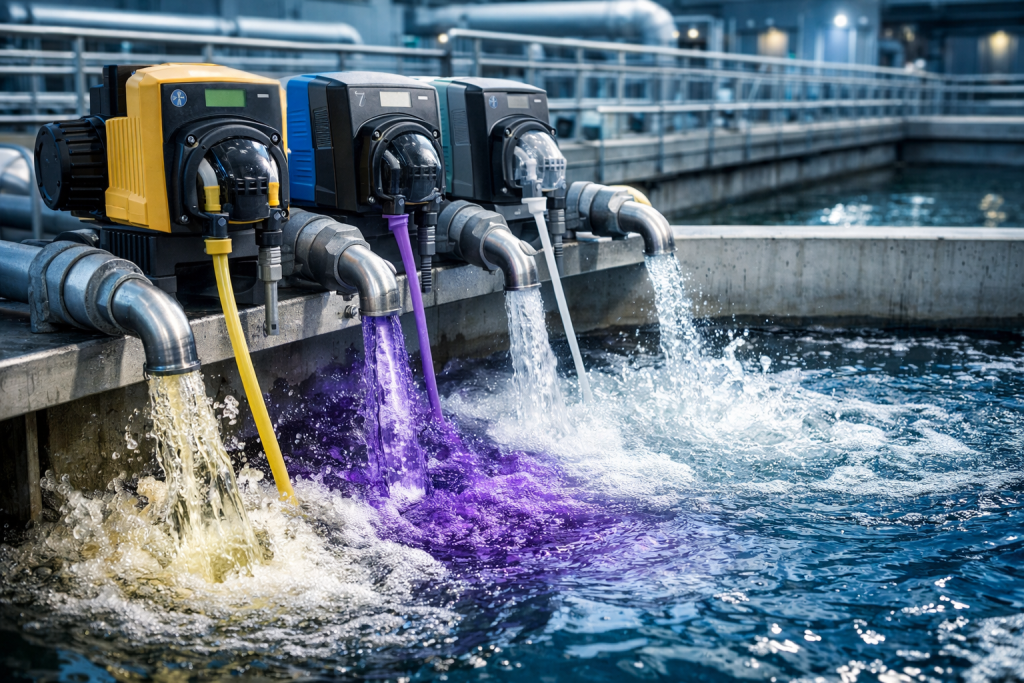
A useful operational advantage: permanganate is deep purple. If you overdose, the colour persists in the treated water—providing a visual alert that something went wrong. After reaction, it forms manganese dioxide solids that settle or filter, removing the oxidized contaminants from the water.
Use potassium permanganate when the problem is iron, manganese, sulfide, or taste-and-odour, not pathogens. It improves treatability upstream; it does not disinfect.
04 — Peracetic AcidModern Wastewater Disinfection Without Chlorine Residuals
Peracetic acid (PAA) is a powerful disinfectant formed from acetic acid and hydrogen peroxide. It is increasingly used for wastewater effluent disinfection, particularly where chlorine residuals create regulatory complexity or environmental concern.
Key characteristics:
- Extremely fast-acting disinfectant, effective even in cold water
- Does not form chlorinated disinfection byproducts (DBPs)
- Breaks down completely to water, oxygen, and acetic acid (no persistent residual)
- Leaves no chlorine residual to protect downstream users—not suitable for drinking water systems
Because peracetic acid leaves no residual, it shines in wastewater applications where you need final disinfection without creating a chlorine residual that would require dechlorination before discharge. It's the modern answer to the question: "How do I disinfect without dechlorination costs?"
Use peracetic acid when disinfecting wastewater effluent and chlorinated byproducts or dechlorination are undesirable or regulatory obstacles.
05 — Side-by-Side ComparisonChoose the Right Chemical for Your Point in the Treatment Train
| Feature | Sodium Hypochlorite | Potassium Permanganate (CAIROX®) | Peracetic Acid |
|---|---|---|---|
| Primary function | Disinfection | Oxidation (pretreatment) | Disinfection |
| Typical use point | Final disinfection, distribution systems | Upstream pretreatment (before clarification) | Wastewater effluent disinfection |
| Chlorine-based | Yes | No | No |
| Leaves a residual | Yes (0.2–0.5 ppm typical) | No (forms solids only) | No (decomposes completely) |
| DBP formation risk | Possible (depends on organic matter) | None | None |
| Cold water performance | Moderate (requires longer contact) | Good (not temperature-dependent) | Excellent (very fast at all temperatures) |
| Visual overdose indicator | No (requires testing) | Yes (purple colour persists) | No (requires testing) |
| Common application | Drinking water & wastewater | Drinking water pretreatment | Wastewater effluent |
| Transport complexity | Low (liquid, atmospheric pressure) | Low (solid powder or suspension) | Moderate (corrosive liquid, DOT regulations) |
| Relative cost | Baseline | Baseline to moderate | Higher (specialty chemical) |
06 — How Well-Run Plants Make the ChoiceMatch the Chemical to the Problem, Not the Problem to the Chemical
If your challenge is pathogen inactivation and you need a residual for distribution system protection: Sodium hypochlorite is the standard choice. It's understood, regulated, and proven at hundreds of utilities. If you're replacing chlorine gas, hypochlorite is the direct equivalent with better safety.
If your challenge is iron, manganese, hydrogen sulfide, or taste-and-odour: Potassium permanganate solves the problem upstream, before filtration. It oxidizes contaminants that would otherwise foul filters or degrade treated water quality. It does not disinfect—but that's not the point. You disinfect with hypochlorite downstream.
If your challenge is wastewater effluent disinfection without chlorine residuals or DBPs: Peracetic acid is the modern solution. It disinfects fast, leaves no chlorine to dechlorinate, and doesn't create environmental concerns downstream.
Reality: Most plants use more than one of these chemicals at different points in the treatment process. Iron-manganese removal plants run permanganate upstream and hypochlorite for final disinfection. Modern wastewater plants run peracetic acid instead of chlorine followed by dechlorination. These are not either-or choices; they are complementary tools.
07 — Operational TakeawayUnderstand What Each Chemical Does and When to Use It
A plant that confuses disinfection with oxidation will apply the wrong chemical at the wrong point and watch treatment fail without understanding why. Iron still colors the water. Taste-and-odour persists. Or disinfection is incomplete because you chose an oxidizer when you needed a disinfectant.
Understand the difference:
- Sodium hypochlorite is your disinfectant. It protects public health by inactivating pathogens. It leaves a residual that persists through distribution systems.
- Potassium permanganate (CAIROX®) is your pretreatment oxidizer. It removes iron, manganese, and odours before they foul your filters or degrade treated water quality.
- Peracetic acid is your wastewater disinfectant when chlorine residuals are undesirable. It disinfects fast and decomposes completely, leaving no environmental burden.
Know what problem you're solving. Choose the chemistry that solves it. Run the same program for 90 days. Measure the results. Then optimize.