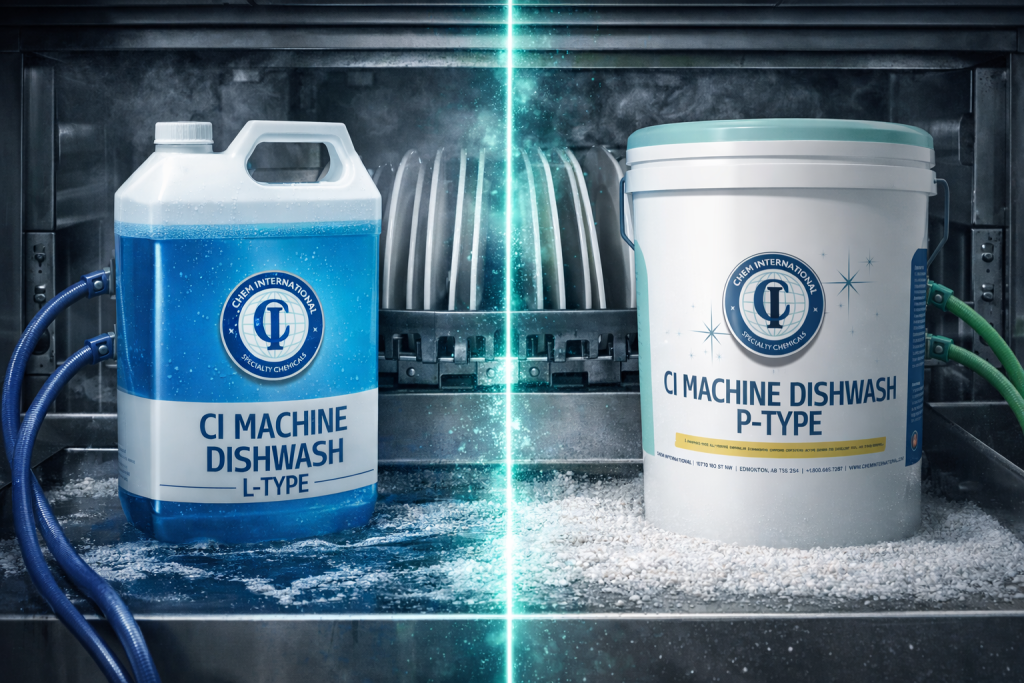
The machine dishwashing decision appears simple: liquid or granular? But behind this choice lies significant chemistry. Each form is engineered for different operational contexts. Liquid detergents (like CI Machine Dishwash L-Type) excel in high-speed, high-volume systems with automated dosing and consistent soil loads. Granular detergents (like CI Machine Dishwash P-Type) deliver flexibility for variable soils, hard water challenges, and equipment with manual or semi-automatic chemical management. The wrong choice leads to spotting, filming, incomplete soil removal, or excessive water consumption. The right choice transforms your dishroom into an efficient, reliable operation. Understanding the technical differences—chemistry, dispensing compatibility, water condition handling, and soil type performance—enables you to make an informed decision that serves your kitchen's actual needs, not a generic prescription.
01 — The FundamentalsLiquid and Granular: What's the Difference?
Liquid and granular detergents perform the same core function—they remove soil from dishes—but they achieve this through different formulation strategies and require different handling.
Granular (P-Type) Detergents
Granular detergents are solid, crystalline powders. CI Machine Dishwash P-Type is a granular, phosphate-free powder engineered for machine dishwashing. Key characteristics:
- Form: Dry powder, stored in bulk bags or containers
- Concentration: 100% active cleaning chemistry (no water carrier)
- Dissolution: Dissolves in the machine's water spray; manual pre-dissolving optional
- Ingredients: Alkaline builders, surfactants, water softeners, active oxygen agents, enzymes, anti-caking agents
- Key advantage: Flexibility; operators can adjust dose or pre-dissolve for specific soil challenges
Liquid (L-Type) Detergents
Liquid detergents are aqueous solutions with active cleaning chemistry dissolved or suspended in water. CI Machine Dishwash L-Type is a high-alkalinity liquid formulated for automated dispensing. Key characteristics:
- Form: Liquid, poured or pumped into the machine's chemical reservoir
- Concentration: Typically 30–50% active cleaning chemistry + water carrier
- Dispensing: Integrated with the machine's automatic dosing system; precise, hands-off
- Ingredients: Alkaline builders, surfactants, corrosion inhibitors, foam suppressants
- Key advantage: Consistency; every wash cycle receives the exact same dose
The Core Difference: Flexibility vs. Precision
Granular detergents offer operational flexibility. An operator can add more product if they encounter a heavily soiled load, or pre-dissolve the granules in water for faster activation in hard water. Liquids offer dosing precision. Automated systems dispense the exact amount every time, eliminating operator error and enabling fine-tuning of chemical cost per wash.
02 — Equipment and Dispensing SystemsMatching Detergent to Machine Type
The type of dishwashing machine you operate—and how it dispenses chemicals—is the first criterion for choosing between liquid and granular.
Granular (P-Type) Machine Compatibility
Granular detergents are suited to:
- Undercounter and conveyor machines with manual chemical dispensing: An operator opens a door or hopper and adds granules directly to the machine's wash chamber or pre-dissolving tray.
- Machines with semi-automatic chemical systems: A button or lever triggers a measured amount of granules to be added.
- High-volume batch operations: Where cleaning needs vary and operators adjust dosage based on soil assessment.
- Machines not equipped with automatic liquid dosing lines: Granules can be added without requiring reservoir integration.
Liquid (L-Type) Machine Compatibility
Liquid detergents are optimized for:
- High-speed conveyor machines with automated chemical injection: The machine's pump dispenses a set amount of liquid per cycle.
- Machines with integrated chemical reservoirs and metering systems: Liquid is drawn from the reservoir and injected into the wash chamber automatically.
- Operations requiring consistent, hands-off dosing: Operators don't handle chemicals; the machine manages dispensing.
- High-volume, fast-paced dishrooms with tight turnaround times: Automation ensures no operator error delays cleaning performance.
03 — Chemistry ComparisonActive Oxygen vs. High Alkalinity: Different Weapons for Different Soils
Active Oxygen: The Granular Advantage
CI Machine Dishwash P-Type contains active oxygen compounds (typically hydrogen peroxide or perborate-based agents). When activated by water and heat, these compounds release oxygen atoms that react with tannin stains (tea, coffee, wine, beet juice) and baked-on organic residues, bleaching them away. This is particularly valuable in:
- Hospitals and healthcare facilities with high stain loads
- Cafeterias serving beverages that leave tannin residues
- Operations where re-washing soiled items is costly in time and labor
High Alkalinity: The Liquid Advantage
CI Machine Dishwash L-Type operates at pH 12–13, which aggressively saponifies (breaks down) fats and oils and rapidly denatures proteins. This is ideal for:
- High-volume restaurants with consistent, heavy grease loads
- Fast-paced operations requiring rapid soil removal in short cycle times
- Dishes made exclusively of steel, ceramic, or glass (where high pH poses no corrosion risk)
04 — Water ConditionsHard Water, Softness, and Detergent Selection
Water hardness—the concentration of dissolved minerals (calcium and magnesium)—significantly impacts detergent performance and selection.
Hard Water: P-Type (Granular) Wins
Hard water contains minerals that interfere with detergent performance. Calcium and magnesium ions react with surfactants, reducing their ability to suspend soil. Traditional solutions include water softening systems (ion exchangers or reverse osmosis), but these require capital investment and maintenance.
Granular detergents like CI Machine Dishwash P-Type include built-in water softeners—typically zeolite (a porous mineral) that captures hardness ions, allowing the detergent's surfactants to work freely. This makes P-Type ideal for operations in hard water areas without capital-intensive water treatment equipment.
Liquid detergents require either softer incoming water or a separate water softening system to perform optimally in hard water. Without water softening, L-Type performance degrades as hardness increases.
Soft or Treated Water: Both Types Perform
If your operation has a water softening system or operates in a soft-water area, both granular and liquid detergents perform equally well. In this case, equipment and operational factors become the deciding criteria.
05 — Soil and Material CompatibilityWhat You're Cleaning Matters
06 — Operational ConsiderationsCost, Training, Storage, and Efficiency
Product Cost and Usage Efficiency
Granular detergents are typically 20–30% cheaper per pound than liquid detergents because they contain no water carrier. However, liquid detergents are dosed automatically, minimizing operator error and product waste. An imprecise granular dose (operator adds too much) is wasted product; an automated liquid dose is precise every time.
For high-volume operations, the cost savings from precision dispensing (liquid) often offset the higher per-pound price. For lower-volume or variable-load operations, the lower per-pound cost of granular makes it more economical despite occasional over-dosing.
Staff Training and Safety
Granular detergents: Operators handle the product directly. Training is simple (add granules to machine), but requires care to prevent inhalation of powder and skin contact.
Liquid detergents: The machine handles chemical dispensing; operators interact minimally with the product. This reduces training complexity and chemical safety concerns. However, if the reservoir needs refilling, operators must handle concentrated liquid.
Storage and Shelf Life
Granular detergents: Store easily in bulk bags; shelf life is very long (1–2 years) as long as granules remain dry.
Liquid detergents: Require enclosed storage in sealed containers to prevent evaporation. Shelf life is moderate (6–12 months). Bulk storage can take more space due to water content.
Flexibility for Variable Operations
A granular detergent allows an operator to adjust dose if a particularly soiled batch arrives. With liquid, dosing is fixed; if a load is unusually heavy, the operator must either run an extra cycle or pre-soak. This can be inefficient.
07 — Decision MatrixChoosing Between P-Type and L-Type
| Scenario / Requirement | Choose P-Type (Granular) | Choose L-Type (Liquid) |
|---|---|---|
| Dispensing System | ✓ Manual or semi-auto | ✓ Fully automated |
| Hard Water | ✓ Excellent (built-in softening) | ⚠ Requires separate water softener |
| Tannin Stains | ✓ Excellent (active oxygen) | ⚠ Fair (requires presoaking) |
| Aluminum Cookware | ✓ Safe (moderate pH) | ✗ Not recommended (high pH) |
| Heavy Grease Loads | ✓ Very good | ✓ Excellent (faster) |
| Fast-Paced, High-Volume | ⚠ Operator-dependent | ✓ Consistent, precise dosing |
| Variable Soil Loads | ✓ Flexible (adjust dose) | ⚠ Fixed dosing per cycle |
| Long Shelf Life / Storage | ✓ 1–2 years, easy to store | ⚠ 6–12 months, requires sealed container |
| Lower Cost per Unit | ✓ 20–30% cheaper per pound | ⚠ Higher per-pound cost |
08 — Implementation GuideTransitioning Between Detergent Types
From Granular to Liquid (P-Type to L-Type)
If you're upgrading to a machine with automated dispensing:
- Verify machine compatibility: Confirm the machine's chemical reservoir and dosing system accept liquid at the concentration you're using.
- Flush the old system: Clear any granular residue from hoppers or pre-dissolving trays to prevent blockages.
- Test cycle dosing: Run test loads to confirm the liquid dose is correct. Adjust the pump setting if needed.
- Train staff: Teach operators how to refill the liquid reservoir and recognize when chemical is running low.
- Monitor results: Watch for spotting, filming, or incomplete soil removal for the first week. If issues appear, the liquid pH may need to be adjusted or the machine's water temperature verified.
From Liquid to Granular (L-Type to P-Type)
If you're switching to a machine without automated liquid dispensing, or want the flexibility of granular chemistry:
- Assess pre-dissolving option: Check if the machine has a pre-dissolving tray or chamber. If yes, pre-dissolve granules in hot water before each cycle for faster activation.
- Establish dosing protocol: Create clear written guidelines for operators specifying the amount of granules per load type (light, standard, heavy soil).
- Test and train: Run test loads with various dose amounts to establish the optimal amount. Train staff on the protocol and the reasoning (why adjust dose for heavy loads).
- Monitor consumption: Track how much granular detergent you're using per day. Compare to your previous liquid consumption to verify dosing is appropriate.
09 — ConclusionThere Is No Universal Answer—Only the Right Answer for Your Operation
The choice between CI Machine Dishwash P-Type (granular) and CI Machine Dishwash L-Type (liquid) is not about which is objectively superior. It is about which solves your specific operational challenges.
Choose P-Type (Granular) if: You operate in hard water, have aluminum cookware, encounter frequent tannin stains, have manual or semi-automatic dispensing, or need flexibility to adjust dose for variable soil loads. P-Type is also the choice for cost-conscious operations comfortable training staff on proper dosing.
Choose L-Type (Liquid) if: You have fully automated dispensing, operate in soft water or have water softening equipment, run high-volume/high-speed operations where consistency is critical, wash primarily steel/ceramic ware, and prioritize hands-off efficiency and staff safety over chemical flexibility.
Chem International offers both solutions precisely because one is not universally "right." The right choice is the one that aligns with your equipment, water conditions, soils, and operational workflow. A hospital with aluminum serving ware in hard water uses P-Type. A fast-paced restaurant with a conveyor machine and soft water uses L-Type. The key is matching chemistry to reality, not forcing your operation into a generic mold.
Start with your constraints: equipment, water conditions, and soil types. Let these facts determine your detergent—not the reverse.