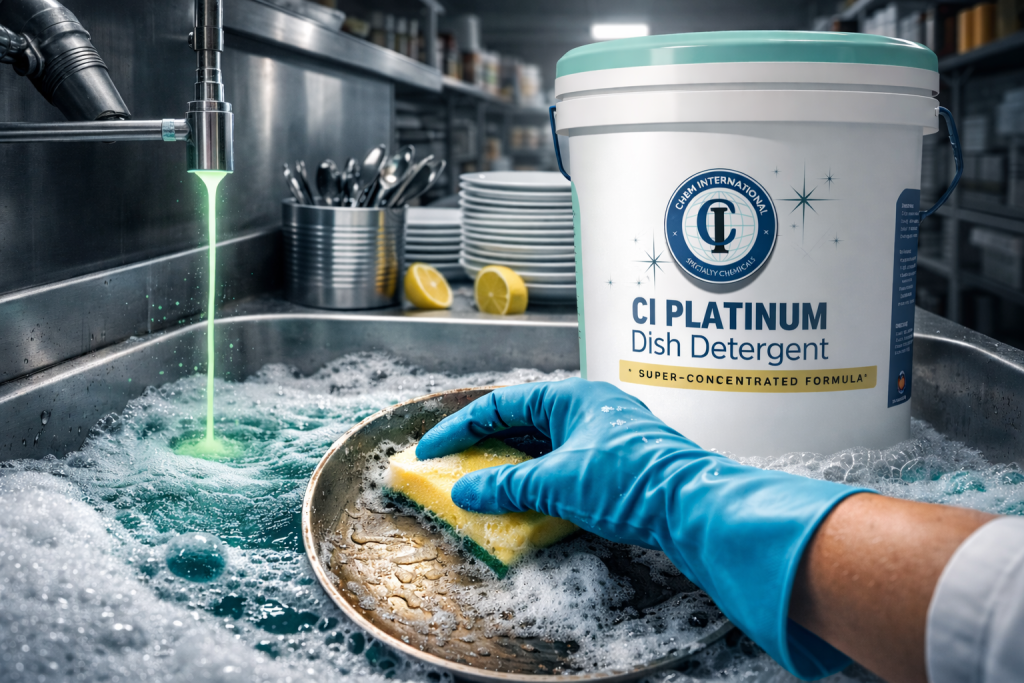
A commercial kitchen dish pit is relentless. Every shift, thousands of plates, pans, utensils, and cooking equipment pass through hot water and detergent. Running costs are measured in labor hours, water consumption, energy, and chemical product. Efficiency matters. One overlooked lever for cost control is the detergent itself. Traditional dish soaps are formulated as thin liquids that require large volumes to generate sufficient suds and break down grease. This means frequent refilling of the wash sink, bulk storage space, and higher total cost per meal served. Super-concentrated detergents—like CI Platinum Dish Detergent at 2X concentration—deliver the same or better cleaning power in half the product, fundamentally changing the economics of manual dishwashing. Fewer refills, less waste, smaller storage footprint, gentler on hands, and compatible with both traditional manual and modern automated dosing systems. For operators serious about controlling costs and improving staff experience, concentration is the overlooked advantage.
01 — The FundamentalsWhat "2X Concentrated" Actually Means
Detergent concentration refers to the percentage of active cleaning ingredients (surfactants, builders, enzymes, and stabilizers) in the formulation. A standard dish detergent is typically 8–12% active ingredients. A concentrated detergent might be 16–20% active ingredients. A 2X concentrated formula contains roughly twice the active cleaning chemistry per unit volume.
This is not marketing speak. It is measurable chemistry. A standard 1 oz dose of traditional detergent delivers a certain amount of surfactant and stabilizing agents. A 0.5 oz dose of 2X concentrated detergent delivers the same amount of cleaning action, for the same results, using half the product.
Why Concentration Matters in Commercial Settings
For a casual home kitchen, using an extra ounce of dish soap per sink is not a cost issue. For a commercial operation washing hundreds of dishes and pans daily, it compounds:
- Cost per wash: A concentrated formula reduces the product cost per dish by 40–50%.
- Refill frequency: Using half the product per sink means half as many refills. For high-volume dish pits, this means fewer labor interruptions.
- Storage space: Less product needed means smaller storage footprint—valuable in space-constrained kitchens.
- Bulk ordering and disposal: Ordering half the volume reduces shipping costs, storage burden, and wastewater volume when diluted and rinsed away.
- Consistency and control: Concentrated detergents are easier to proportion correctly. A smaller dose is less likely to be over-dosed accidentally.
For a large catering facility or institutional kitchen washing 2,000+ dishes daily, these "small" efficiencies compound into significant annual cost savings.
02 — The ChemistryHow Concentrated Detergents Work Harder in Less Volume
Surfactants: The Core of Cleaning Power
Surfactants (surface-active agents) are the workhorses of any dish detergent. They have a unique molecular structure: one end is hydrophilic (water-loving) and the other is lipophilic (oil-loving). This property allows them to surround oil and grease particles, breaking them apart into smaller droplets that can be suspended in water and rinsed away.
A concentrated detergent contains significantly more surfactant molecules per unit volume. This means:
- Faster grease emulsification: More surfactant molecules are available to surround and break down grease more quickly.
- Better suspension: Loosened food soil stays suspended in the wash water rather than settling back onto dishes.
- Cleaner rinse: Less residue is left behind because more soil has been emulsified and removed.
Stable Sudsing: Why Foam Matters
Commercial dishwashing relies on visible suds. Suds indicate active detergent; they also trap soil particles and grease, carrying them away from the dish surface. Traditional detergents require larger volumes to maintain suds throughout a long wash cycle.
Concentrated detergents use stabilizing agents and foam enhancers that maintain suds with less product. CI Platinum Dish Detergent includes aggressive surfactants and stable sudsing agents specifically engineered to:
- Generate rich, persistent foam even at lower concentrations
- Maintain suds quality throughout extended wash periods
- Resist collapse from grease and soil loading
Breaking Down Baked-On and Hardened Residue
Commercial dishwashing involves far more than plates and glasses. Roasting pans, sheet pans, sauté pots, and prep tools come to the dish pit caked in hardened grease, carbonized food, protein residues, and starch. These require aggressive chemistry to dissolve and dislodge.
A concentrated detergent delivers more active chemistry to attack these challenging soils:
- Protein breakdown: Detergent chemistry denatures and hydrolyzes protein-based residues, making them lose adhesion to the surface.
- Grease saponification: Alkaline builders in the detergent convert fats and oils into soap-like compounds that rinse away easily.
- Starch dissolution: Enzymatic and chemical action breaks down starch-based residues from sauces and starches.
03 — Soil Types in Commercial DishwashingWhat Your Dish Pit Is Actually Cleaning
Not all dish soil is the same. Understanding the types of residues your detergent must handle is critical to selecting the right product.
Professional dish detergents must handle all four soil types simultaneously. A concentrated detergent brings the full arsenal—alkaline builders, surfactants, enzymes, and stabilizers—at higher concentrations, enabling faster, more complete soil removal even with smaller doses.
04 — Hand Safety and pHGentle Chemistry That Still Cleans Aggressively
Dishwashing is a human-intensive operation. Workers handle the detergent constantly—splashing it, spraying it, working in it for hours. Extended exposure to aggressive alkaline detergents can lead to skin irritation, dryness, dermatitis, or chemical burns in severe cases. This is not a minor concern in food service labor-intensive environments.
Why pH Matters
Human skin is naturally acidic, with a pH of 4.5–5.5. Alkaline detergents (pH 10–13) disrupt this protective acid mantle, stripping natural oils from the skin and causing irritation or damage with repeated exposure. Alkaline pH also increases the risk of chemical burns if the product contacts eyes or mucous membranes.
Traditional commercial dish detergents operate at pH 10–12 to deliver powerful cleaning. This is effective for soil removal but requires workers to wear gloves and limits prolonged skin contact.
The Advantage of Neutral pH
CI Platinum Dish Detergent is formulated at neutral pH (6.5–7.5), a significant departure from traditional high-pH detergents. This achieves aggressive cleaning without the alkaline burden on skin. How is this possible?
- Aggressive surfactants: More powerful, modern surfactant chemistry that works effectively at lower pH.
- Enzyme systems: Added enzymes (protease, lipase, amylase) break down protein, fat, and starch soils without requiring high alkalinity.
- Organic builders: Modern chelating agents and builders work at neutral pH where traditional silicate/carbonate builders require alkalinity.
- 2X concentration: Higher active ingredient concentration means the formula works harder and faster, compensating for neutral pH.
Benefits of Neutral-pH Detergent for Dish Pit Operations
The combination of 2X concentration with neutral pH represents a meaningful shift in detergent chemistry: you get the cleaning power of traditional alkaline detergents without the hand safety concerns.
05 — Dispensing and ControlManual vs. Automated Application
Traditional Manual Dispensing
In most commercial kitchens, a dish worker manually adds detergent to the wash sink—usually a squeeze bottle or dipper. This introduces the risk of over-dosing (workers add too much) or under-dosing (trying to "save" detergent). Both hurt performance: over-dosing wastes product and makes rinsing harder; under-dosing leaves dishes not fully clean.
Concentrated detergents are easier to proportion correctly. A smaller dose (0.5 oz instead of 1.0 oz) is less likely to be accidentally over-dosed. It is also more obvious if the dose is too small—a smaller amount is harder to hide.
Automated Dosing Systems
Larger operations are increasingly adopting automated dosing systems: pump dispensers that deliver a precise amount of product per sink fill or per timed interval. Automated systems:
- Eliminate operator error in dosing
- Reduce product consumption through precision
- Provide consistent cleaning performance
- Allow for easy adjustment of dose if needed
CI Platinum Dish Detergent is optimized for both manual and automated application. The viscosity and flow characteristics work equally well with squeeze bottles, dippers, and pump dispensers. The concentration allows for precise dosing in automated systems while remaining effective in manual applications.
Water Temperature and Detergent Performance
Hot water accelerates detergent performance. Most commercial dishwashing occurs in hot water (140–160°F), which is ideal for detergent activation and soil removal. A concentrated detergent works well in this range, delivering full cleaning power at standard wash temperatures.
For operations using cooler wash water (80–120°F), a concentrated detergent still performs, but a slightly higher dose or longer soak time may be needed. The formula is flexible enough to accommodate both scenarios.
06 — Cost AnalysisThe Real-World Economics of Concentration
Let's quantify the advantage. Assume a medium-sized commercial kitchen (restaurant, catering facility) washing 500 dishes per day, 6 days/week, 50 weeks/year = 150,000 dishes annually.
Traditional Dish Detergent (1X concentration)
- Dose per sink: 1.0 oz
- Sinks per day (assuming 3–4 refills): 4 sinks × 1.0 oz = 4 oz/day
- Annual consumption: 4 oz/day × 6 days/week × 50 weeks = 1,200 oz/year = 9.4 gallons/year
- Cost per gallon: $8–12 (typical range)
- Annual product cost: 9.4 gal × $10 = $94/year
2X Concentrated Dish Detergent (CI Platinum)
- Dose per sink: 0.5 oz
- Sinks per day (fewer refills): 2 sinks × 0.5 oz = 1 oz/day
- Annual consumption: 1 oz/day × 6 days/week × 50 weeks = 300 oz/year = 2.34 gallons/year
- Cost per gallon: $16–18 (premium pricing due to concentration)
- Annual product cost: 2.34 gal × $17 = $40/year
Net Annual Savings
$94 – $40 = $54/year in product cost for this medium operation. For larger kitchens washing 1,000+ dishes daily, the savings scale proportionally to $100–200+ annually. Add in reduced storage space, fewer refills (labor savings), and reduced wastewater disposal fees, and the total savings can exceed 50% of the detergent budget.
07 — Practical ApplicationHow to Switch to Concentrated Detergent
Understanding Dilution and Dosing
If your operation currently uses a standard dish detergent, switching to 2X concentrated is straightforward:
- Direct substitution: Use half the usual dose. If you add 1 oz of standard detergent, add 0.5 oz of concentrated.
- Visual cues: The foam level should be similar. If you get noticeably less foam, you may have under-dosed. If excessive foam (overflowing), you may have over-dosed.
- Test period: Run a 1–2 week trial to train staff on the new dose and observe cleaning results. Adjust if needed.
Training and Communication
The most common issue in switching to concentrated detergent is staff habit. Workers accustomed to using a full squeeze bottle of standard detergent may instinctively reach for the same amount of concentrated product. This over-doses the sink and wastes money.
Clear communication is essential: post instructions at the sink showing the new dose, mark bottles or dispensers with the correct amount, and briefly train staff on why the dose is different. Emphasize that less product = same cleaning = lower cost for the facility.
Monitoring and Adjustment
After switching, monitor:
- Cleaning results: Are dishes and pans coming out clean? Any remaining soil or residue? If yes, dose may be too low for your specific soil load—adjust up slightly.
- Suds quality: Adequate foam should be visible. Weak suds suggest under-dosing. Excessive overflow suggests over-dosing.
- Product consumption: Track how often you refill containers. It should be significantly less frequent (roughly half as often).
- Staff feedback: Ask workers if they notice any difference in hand irritation, skin dryness, or ease of rinsing. Neutral-pH formulas should feel gentler.
08 — TroubleshootingCommon Issues When Switching to Concentrated Detergent
Dishes Still Have Residue or Film
Likely cause: Under-dosing (too little detergent), or water temperature too cool.
Solution: Increase dose slightly and ensure wash water is hot (140–160°F minimum). Run a test sink with higher dose to confirm improvement. If problem persists, water hardness or rinse water quality may be an issue—ensure rinse water is clean and not overly hard.
Excessive Foam or Overflow
Likely cause: Over-dosing (staff habit from previous detergent).
Solution: Retrain staff on correct dose. Post visual markers on bottles or dispensers showing the correct amount. CI Platinum is stable and doesn't produce excessive foam even at higher doses, but over-dosing still wastes product.
Higher Water Use or Rinsing Difficulty
Likely cause: Residual detergent left on dishes—usually from over-dosing or inadequate rinse.
Solution: Reduce dose to correct amount. Ensure rinse water is adequate and that the rinse cycle is long enough to remove all detergent. Concentrated formulas rinse cleanly when dosed correctly.
Hand Irritation Despite Neutral pH
Likely cause: Over-dosing creates higher local pH when the product is not fully diluted, or workers are not using gloves when handling undiluted product.
Solution: Ensure dose is correct. Remind staff to use gloves when handling undiluted detergent. Rinse hands thoroughly after contact. CI Platinum is gentler than traditional alkaline detergents, but concentrated product before dilution in the sink should still be handled with care.
09 — ConclusionConcentration Is the Overlooked Advantage in Commercial Dishwashing
Manual dishwashing in commercial kitchens is labor-intensive and chemical-intensive. Most facility managers focus on labor costs and ignore the leverage available in the detergent itself. This is a mistake. Switching from standard to super-concentrated dish detergent—specifically a 2X concentrated formula like CI Platinum Dish Detergent—fundamentally improves the economics of dishwashing:
- Cost reduction: 40–50% lower product cost per wash
- Operational efficiency: Fewer refills, smaller storage footprint, less waste
- Staff safety: Neutral pH reduces hand irritation and chemical burn risk
- Flexibility: Works equally well in manual and automated dosing systems
- Performance: Aggressive surfactants and enzyme systems deliver superior cleaning of baked-on and hardened residues
For high-volume operations, the savings are material. For smaller kitchens, the improved safety and reduced storage burden are meaningful. And for all operations, the knowledge that you're using a product engineered for concentration—not just diluted standard detergent—provides confidence that you're getting true industrial performance.
Don't just measure dishwashing by labor hours. Measure it by cost per dish cleaned. Measure it by staff comfort. Measure it by storage footprint and waste. Concentrated detergent wins on all counts.