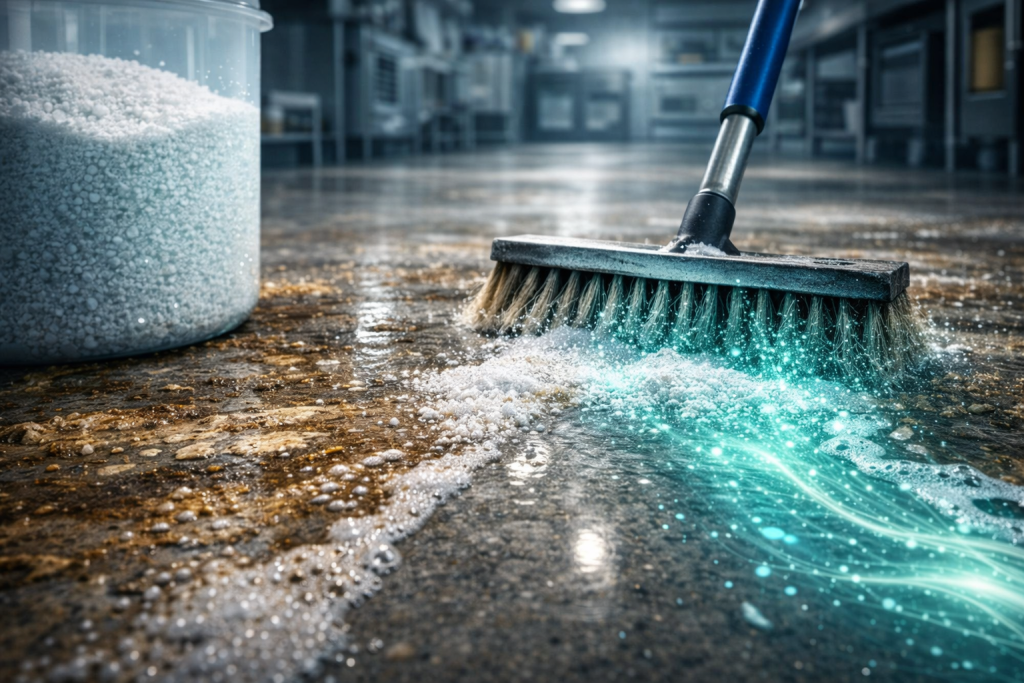
Commercial kitchen floors are under assault. Hot cooking oil spatters across concrete, protein-rich residues from food prep accumulate in cracks, grease from equipment leaks pools in the corner, and the high-traffic environment ensures nothing stays clean for long. A mop-and-bucket approach handles daily light soil removal, but it cannot address embedded grease in concrete's porous structure. That's where granular alkaline cleaners step in—combining chemical degreasing action with mechanical abrasion to dissolve, dislodge, and suspend contaminants that liquid cleaners alone cannot reach. The result is concrete that is truly clean, safe to walk on, and ready to meet the strict sanitation standards food service operations demand.
01 — The ProblemWhy Concrete Demands Special Degreasing Chemistry
Concrete is durable and affordable—ideal for commercial kitchen floors. But its strength is also its weakness: the material is porous. Microscopic capillary voids throughout the concrete surface allow liquids to penetrate and deposit solid residues deep within the structure. Once embedded below the surface, grease and oil become invisible to casual inspection but continue accumulating, layer upon layer, shift after shift.
How Porosity Creates the Problem
Concrete's porosity ranges from 8–15% of the material's volume, depending on the mix and curing. This means water and contaminants don't just sit on the surface—they soak in. In a commercial kitchen, this has specific consequences:
- Grease penetration: Hot cooking oil (300–400°F) is absorbed rapidly into concrete pores. As it cools, it solidifies, trapping in place and becoming nearly insoluble in water.
- Repeated layering: Daily oil and grease deposition builds layer upon layer in the porous structure. Surface cleaning only removes recent deposits; older, embedded residue remains.
- Bacterial and mold growth: The combination of moisture, organic residue, and warm conditions (typical in kitchens) creates an ideal environment for bacterial colonization and biofilm formation deep in the pores.
- Slip hazard acceleration: As embedded grease accumulates, even after mopping, the surface remains slippery due to residual oil in the pores being brought to the surface by moisture and foot traffic.
Why Liquid Cleaners Aren't Enough
Liquid degreasers—even alkaline ones—can suspend and emulsify oils on the surface and in shallow pores. But they rely entirely on chemical action. In deep concrete pores where grease is heavily embedded and has solidified, liquid cleaners cannot penetrate deeply enough to dislodge the contaminants. Additionally, liquid cleaners provide no mechanical scrubbing action—they cannot abrade or physically break up buildup.
For heavy-duty degreasing, you need both chemical and mechanical action working simultaneously. That is what granular alkaline cleaners deliver.
02 — The ChemistryHow Granular Alkaline Cleaners Work
Granular alkaline floor cleaners combine high-pH chemical builders, surfactants, and physical abrasive particles into a single formulation. When applied with water to concrete and agitated with a deck brush, three processes work simultaneously to remove grease.
Chemical Degreasing: Breaking Down Oils
The granular cleaner contains alkaline compounds—typically sodium carbonate (Na₂CO₃) and sodium silicate (Na₂SiO₃)—that achieve pH 12–13 when dissolved in water. At this high pH, alkaline solutions perform two critical functions:
Saponification: The alkaline solution chemically converts fats and oils into soap-like compounds (fatty acid salts) that are water-soluble. This is the same reaction used to make traditional soap from animal fats. In concrete, it converts sticky, hydrophobic grease into compounds that rinse away easily.
Protein denaturation: Food residues contain proteins (meat, dairy, eggs) that bond to concrete surfaces. High pH denatures these proteins—unravels their molecular structure—making them lose adhesion and become more susceptible to removal.
Mechanical Abrasion: Physical Removal
The granular form is key. As you dissolve the granules in water and agitate with a deck brush, the solid particles provide physical scrubbing action. This accomplishes what liquid cleaners alone cannot:
- Physically breaks up hardened, embedded grease
- Dislodges buildup from deep in concrete pores through mechanical action
- Accelerates chemical action by exposing fresh surface area to the alkaline solution
Emulsification: Suspending Contaminants
Modern granular formulations include surfactants and emulsifiers that surround loosened oil particles, preventing them from re-depositing on the concrete. This allows the combined mechanical and chemical action to lift contaminants away so they can be rinsed out with water, rather than being pushed around the floor or settling back into pores.
03 — Granular vs. Liquid CleanersWhen to Use Each Type
Best practice combines both approaches: Use liquid degreasers daily for routine maintenance and fresh spill cleanup. Use granular alkaline cleaners weekly or bi-weekly for deep, heavy-duty degreasing that addresses embedded contaminants and keeps concrete truly clean.
04 — CI Pine Floor CleanerModern Granular Alkaline Degreasing
CI Pine Floor Cleaner is a premium granular alkaline floor cleaner specifically formulated for commercial kitchen environments. It combines proven alkaline chemistry with modern performance enhancers and natural antimicrobial properties.
Key Features and Chemistry
- High alkalinity (pH 12–13): Delivers powerful saponification and protein denaturation for grease and food residue removal.
- Granular formulation: Provides mechanical abrasion action that liquid cleaners cannot deliver. Solid particles break up and dislodge embedded grease.
- Pine oil enhancement: Natural pine oil adds antimicrobial properties and imparts a fresh, clean scent—important in food service environments concerned with odor control.
- Surfactant package: Advanced emulsifiers suspend loosened soil and prevent re-deposition, ensuring contaminants rinse away cleanly.
- Phosphate-free formulation: Meets environmental and wastewater compliance requirements without compromising cleaning power.
Application for Different Soil Levels
CI Pine Floor Cleaner is versatile and can be applied at different concentrations depending on the severity of soil:
- Light maintenance cleaning: Sprinkle granules on damp floor, scrub with soft deck brush, and rinse. The granules dissolve and provide moderate cleaning power.
- Moderate buildup: Apply heavier concentration of granules, scrub vigorously with medium-stiff deck brush, allow 5–10 minutes dwell time, then rinse thoroughly.
- Heavy grease accumulation: Use full-strength granules, apply to wet floor, scrub aggressively with stiff brush, allow 10–15 minute dwell time to allow deep penetration, then scrub and rinse multiple times until water runs clear.
05 — Application TechniqueHow to Get Maximum Performance from Granular Cleaners
Surface Preparation and Precleaning
Before applying granular cleaner, remove loose debris (food waste, large soil particles) with a broom. This prevents debris from clogging the granules and interfering with contact between the cleaner and the concrete surface.
Water Management
The concrete should be damp—not soaking wet and not dry. Water serves two purposes: it activates and dissolves the granules, and it provides the liquid medium needed for the alkaline solution to work. If the floor is too dry, the granules won't dissolve properly. If it's soaking wet, you're diluting the chemistry too much.
Application and Agitation
Sprinkle or scatter granules evenly across the floor. Then scrub with a deck brush using firm, circular motions. The scrubbing action serves three purposes:
- Helps dissolve the granules and activate the chemistry
- Provides the mechanical abrasion that breaks up and dislodges embedded grease
- Works the solution into pores to ensure deep penetration
Dwell Time
After initial scrubbing, allow the solution to dwell (remain in contact with the floor) for 5–15 minutes depending on soil severity. During dwell time, the alkaline solution continues penetrating concrete pores and softening embedded grease. Do not allow dwell time to exceed 20 minutes—residue can begin to re-harden.
Final Scrubbing and Rinsing
After dwell time, scrub again to break up and suspend loosened grease. Then rinse thoroughly with clean water, multiple times if necessary. Continue rinsing until water runs clear and you can no longer smell the cleaner. Residual alkaline cleaner left on the floor will make it slippery and can interfere with other products.
06 — Integration with Maintenance ProgramsBalancing Daily and Deep Cleaning
The most effective kitchen floor maintenance programs use a tiered approach:
- Daily: Damp mop with liquid degreaser to remove fresh soil and spills. This is fast, requires no scrubbing, and keeps the floor acceptably clean for staff safety and food safety compliance.
- Weekly or bi-weekly: Deep clean with granular alkaline cleaner (CI Pine Floor Cleaner). This addresses embedded grease that daily cleaning cannot reach, restoring the concrete to genuinely clean.
- Monthly or quarterly: Enhanced deep clean with extended dwell time and vigorous scrubbing for heavily trafficked areas or seasonal buildup.
This approach balances labor efficiency (daily cleaning is faster) with cleaning effectiveness (weekly deep cleaning keeps grease from accumulating to levels that compromise safety or sanitation).
07 — TroubleshootingCommon Issues and Solutions
Floor Still Feels Slippery After Cleaning
Likely cause: Insufficient rinsing, residual cleaner or grease remaining on surface.
Solution: Rinse again with clean water, multiple times if necessary. Ensure water is running clear and you cannot smell the cleaner. For persistent slipperiness, repeat cleaning with dwell time, then rinse exhaustively.
Granules Don't Dissolve
Likely cause: Floor too dry when granules are applied, or water temperature too cold.
Solution: Ensure floor is damp (not wet) before applying granules. Warm water (90–110°F) activates granules faster than cold water. If using cold water, allow extra dwell time for dissolution.
Visible Streaking or Uneven Cleaning
Likely cause: Uneven application of granules, or insufficient scrubbing in some areas.
Solution: Apply granules more evenly across the floor. Scrub thoroughly, ensuring all areas receive vigorous agitation. Pay special attention to high-traffic areas and areas near equipment where grease accumulation is heaviest.
Grease Returns Within Days
Likely cause: Heavy ongoing grease deposition (normal in busy kitchens) or incomplete removal of embedded grease during cleaning.
Solution: Increase cleaning frequency (weekly instead of bi-weekly). This prevents buildup from re-accumulating. Additionally, ensure equipment is functioning properly (no leaking oil) and that hot grease is being properly captured and disposed of, not draining to the floor.
08 — ConclusionGranular Alkaline Chemistry Is Essential for Kitchen Floors
Liquid degreasers have a role in daily kitchen floor maintenance. But when it comes to addressing embedded grease in concrete—the reality of every busy commercial kitchen—granular alkaline cleaners are the solution. Their combination of chemical degreasing power and mechanical abrasion action removes grease that liquids alone cannot reach.
CI Pine Floor Cleaner brings modern formulation to this proven chemistry: high alkalinity for powerful degreasing, granular form for mechanical action, pine oil for antimicrobial benefits and fresh scent, and phosphate-free formulation for environmental responsibility.
Integrated into a tiered maintenance program—daily liquid cleaning for maintenance, weekly granular deep cleaning for heavy-duty degreasing—concrete kitchen floors stay genuinely clean, safe to walk on, and compliant with food service sanitation standards.
Your concrete is porous. Your grease embeds deep. Granular alkaline chemistry is the solution that reaches where liquid cleaners cannot.