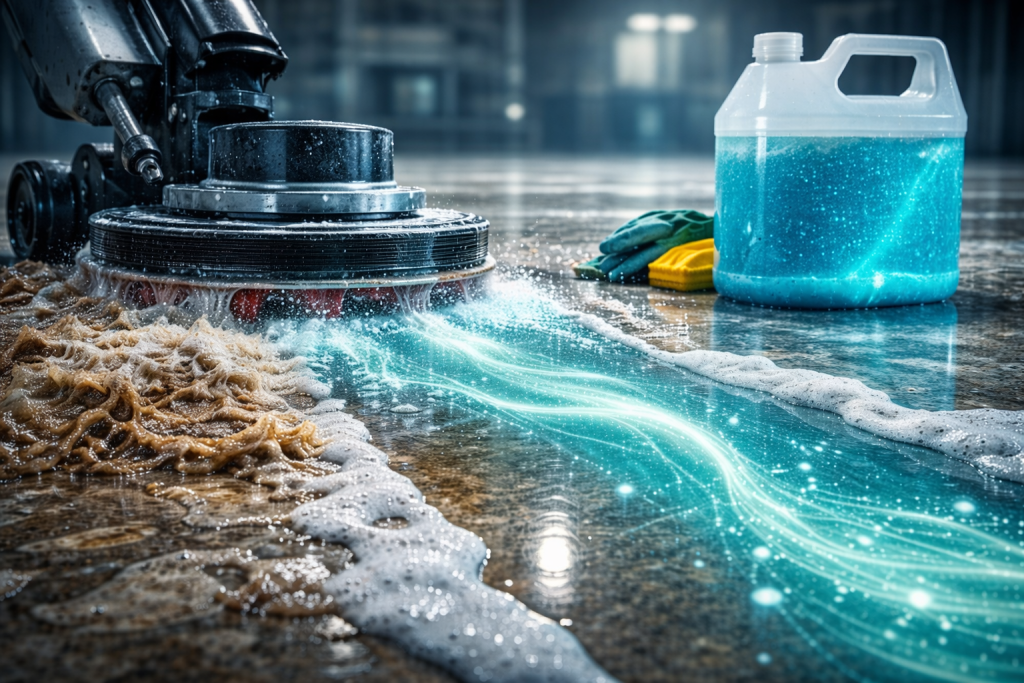
Floor stripping is one of the most labor-intensive, chemically demanding procedures in facility maintenance. A crew spends hours mop-on, scrubbing, and wet-vacuuming to remove layer after layer of worn finish, yet incomplete removal leaves a hazy, dull surface that rejects new finish or looks unprofessional. The problem is rarely technique—it is chemistry. Wrong chemistry means multiple passes, wasted product, wasted labor, and floors that are never truly clean. The right chemistry—one that properly breaks down the polymer film, suspends residue, and can be thoroughly rinsed—makes stripping efficient and leaves floors ready for fresh finish. Understanding alkaline chemistry, why it works, and what happens after the stripping is complete is the difference between competent floor maintenance and frustrated crews returning to the same floor in six months.
01 — The ChallengeWhy Floor Finishes Resist Removal
Modern floor finishes are polymer films engineered to survive mechanical wear, chemical exposure, and moisture. High-solids acrylic or urethane finishes create dense, cross-linked polymer networks—exactly the property that makes floors look beautiful and last long. These same cross-linked polymers are hydrophobic (water-repellent) and chemically inert, making them resistant to water-based cleaning solutions.
Traditional stripping attempted to overcome this through mechanical agitation: scrubbing, buffing, or abrading the finish until it loosened and could be mop-vacuumed away. This approach is labor-intensive, time-consuming, and often incomplete. Chemical stripping offers a better solution: use alkaline chemistry to chemically break down the polymer bonds, saponify waxes and oils, and suspend the finish particles in solution so they lift cleanly.
What Makes Polymers Resistant?
Floor finish polymers are held to the floor substrate through adhesive bonds and through mechanical interlocking (the finish settles into microscopic surface irregularities). Additionally, the polymers are cross-linked—their molecular chains are bonded to each other, creating a three-dimensional network. This cross-linking is what gives the finish durability and hardness, but it also makes the polymer insoluble in plain water. To remove a cross-linked polymer, you must either:
- Break the cross-links chemically (what alkaline strippers do), or
- Penetrate and disrupt the polymer mechanically (which is slow and incomplete), or
- Dissolve the polymer in an organic solvent (which is toxic, slow-drying, and environmentally problematic)
Alkaline chemistry is the most efficient approach, which is why it is the standard in professional floor care.
02 — The ChemistryHow Alkaline Strippers Break Down Finishes
Alkaline floor strippers work through two primary mechanisms: saponification and emulsification. Understanding these processes explains why pH level matters so much in stripper performance.
Saponification: Breaking Down Oils and Waxes
Many floor finishes contain wax components or oily additives for gloss and slip resistance. Saponification is a chemical reaction where a strong alkaline solution (typically sodium hydroxide or potassium hydroxide at pH 12–14) reacts with these fats and oils, converting them into soap-like salts that are water-soluble and easily removed.
The reaction is: Fat/Oil + NaOH → Soap + Glycerin
This is the same chemistry used to make soap from animal fats. In floor stripping, it converts slippery, water-resistant wax layers into water-soluble compounds that can be mopped away.
Emulsification: Suspending Polymers in Solution
The polymers in floor finishes are not saponifiable—they cannot be converted into soap-like compounds. Instead, alkaline strippers contain surfactants (emulsifiers) that surround polymer particles, reducing their surface tension and suspending them in water. This prevents the polymer particles from settling back onto the floor or re-adhering to the surface.
As alkaline solution penetrates beneath the finish film, it disrupts adhesive bonds and lifts polymer particles. The surfactants keep these particles suspended in the stripper solution so they can be removed via mop or wet vacuum, rather than re-depositing on the floor.
Higher pH means faster chemical activity, deeper penetration, and more complete finish dissolution. However, higher pH also means greater safety hazards (chemical burns), more environmental impact, and more aggressive effects on floor substrates (some stone and tile can be etched by pH 13+ solutions). The optimal pH balances stripping power with safety and floor protection.
03 — Stripper TypesTraditional vs. Modern Formulations
CI UltraStripX is a modern concentrated floor stripper formulated for deep penetration and complete finish removal without harsh solvents or excessive odor. At pH 12.5–13, it delivers strong alkaline action while remaining safe for application in occupied spaces. Its concentrated formula means you dilute it to the appropriate strength for your specific application—light buildup requires less concentration, heavy multi-layer buildup requires stronger solution.
04 — Application TechniqueHow to Strip Correctly
Chemistry does the heavy lifting, but proper application technique ensures complete, clean removal without damage to the floor substrate.
Dwell Time: The Critical Window
Dwell time is the amount of time the stripper remains on the floor after application. During dwell time, the alkaline solution penetrates beneath the finish, saponifies waxes, breaks adhesive bonds, and emulsifies polymers.
Optimal dwell time: 5–10 minutes. If applied and immediately mopped away, the stripper lacks time to work. If left too long (20+ minutes), it begins to dry, the finish can re-harden, and residue can re-deposit. The 5–10 minute window allows full penetration and emulsification without these problems.
Concentration and Dilution
Concentrated strippers like CI UltraStripX must be diluted with water before use. Appropriate dilution depends on the condition of the floor:
- Light finish (1–2 coats, recent application): Dilute to 1:4 or 1:5 (1 part stripper to 4–5 parts water). Weaker solution still strips efficiently but reduces chemical intensity.
- Heavy buildup (8–12 coats, aged finish): Dilute to 1:2 or 1:3. Stronger solution penetrates thicker polymer layers and tougher adhesion.
- Standard maintenance stripping (4–6 coats): Dilute to 1:3 or 1:4 as a baseline. Adjust up or down based on results in test area.
Removal Method: Mopping vs. Machine
Once stripper has had its dwell time, the suspended finish residue must be removed. Two approaches are common:
Mop and wet vacuum: Traditional approach. After dwell time, mop or manually scrub the area to loosen residue, then use a wet vacuum to extract the stripper and suspended finish. This is labor-intensive but gives good control and works on any floor type.
Autoscrubber or automatic stripper machine: Mechanical agitation combined with extraction. Faster than manual mopping, particularly on large areas. Requires proper equipment setup to avoid damage.
For most commercial facilities, a combination approach works well: manual mop-on of stripper for penetration, then autoscrubber extraction for efficiency.
05 — The Critical Post-Strip StepNeutralization and Residue Removal
Many facility managers consider stripping complete once the old finish is mopped away. This is a critical mistake. Residual alkaline stripper remaining on the floor will interfere with new finish adhesion, cause cloudiness or dullness, and eventually contribute to corrosion of the floor substrate.
Consequences of Inadequate Post-Strip Neutralization
Proper Post-Strip Protocol
After removing all stripper solution and finish residue, perform a multi-step neutralization and rinse:
- First rinse with plain water. Use clean water and mop or extraction to remove the bulk of stripper solution. Change water frequently—stripper-laden water just redistributes residue.
- Acidic rinse (optional but recommended). CI Industrial Vinegar (5% acetic acid) can be mopped on as a dilute solution (1:1 with water) to neutralize residual alkalinity. Mop or scrub briefly, then extract. This ensures the floor pH returns to neutral.
- Final plain-water rinse. After the acidic rinse, rinse again with plain water to remove vinegar and any remaining residue. The floor should smell neutral—not of stripper or vinegar—when dry.
- Allow complete drying. Stripper residue and mineral deposits remain visible if the floor is wet. Allow the floor to dry completely (2–4 hours depending on humidity and ventilation) before inspecting. Any remaining residue, haze, or discoloration will be obvious on dry floor.
If haze or residue remains after this protocol, repeat the acidic rinse and water rinse. Do not apply new finish over an inadequately neutralized floor—the result will be disappointing.
06 — TroubleshootingCommon Stripping Problems and Solutions
Finish Doesn't Lift or Remains Stubborn
Likely cause: Stripper concentration too weak, dwell time too short, or finish too heavily built up.
Solution: Increase stripper concentration (mix stronger). Allow longer dwell time (8–10 minutes). For heavily built-up floors, may require two passes: first pass to partially strip, rinse, then second pass to strip completely. Never try to force it with aggressive scrubbing—let chemistry do the work.
White/Gray Haze or Residue After Stripping
Likely cause: Residual stripper or mineral deposits from water used in extraction.
Solution: Perform acidic rinse with CI Industrial Vinegar, followed by final water rinse. The haze should disappear as residue neutralizes and dissolves.
Floor Is Slippery or Feels Soapy
Likely cause: Residual saponified wax (soap) or emulsifier left on the floor.
Solution: Additional water rinses will remove residual soap. Wet vacuum extraction is essential to remove these soapy residues—mopping alone won't get them out.
Concrete or Stone Appears Etched or Discolored
Likely cause: Over-concentration of stripper or excessive dwell time on sensitive substrates (marble, limestone, some terra cotta).
Solution: Prevention is key—test stripper concentration on inconspicuous area first. For discoloration that persists, it may be permanent damage to the stone surface. Future stripping on sensitive surfaces requires more dilute solution and shorter dwell time.
07 — ConclusionStripping Is Chemistry First, Labor Second
The most efficient, cost-effective floor stripping programs rely first on the right chemistry—a stripper formulated with alkaline power, efficient penetration, and clean residue removal. Modern concentrated strippers like CI UltraStripX exemplify this approach: they deliver industrial-strength stripping without harsh solvents, excessive odor, or ventilation challenges.
Combined with proper application technique (appropriate dwell time, dilution, and removal method) and critical post-strip neutralization (using CI Industrial Vinegar to ensure the floor is pH-balanced before new finish), the result is a clean, chemically neutral floor ready for beautiful, durable new finish.
Invest in stripper chemistry. Master the technique. Prioritize post-strip neutralization. Your floor restoration will be faster, cleaner, and more professional.