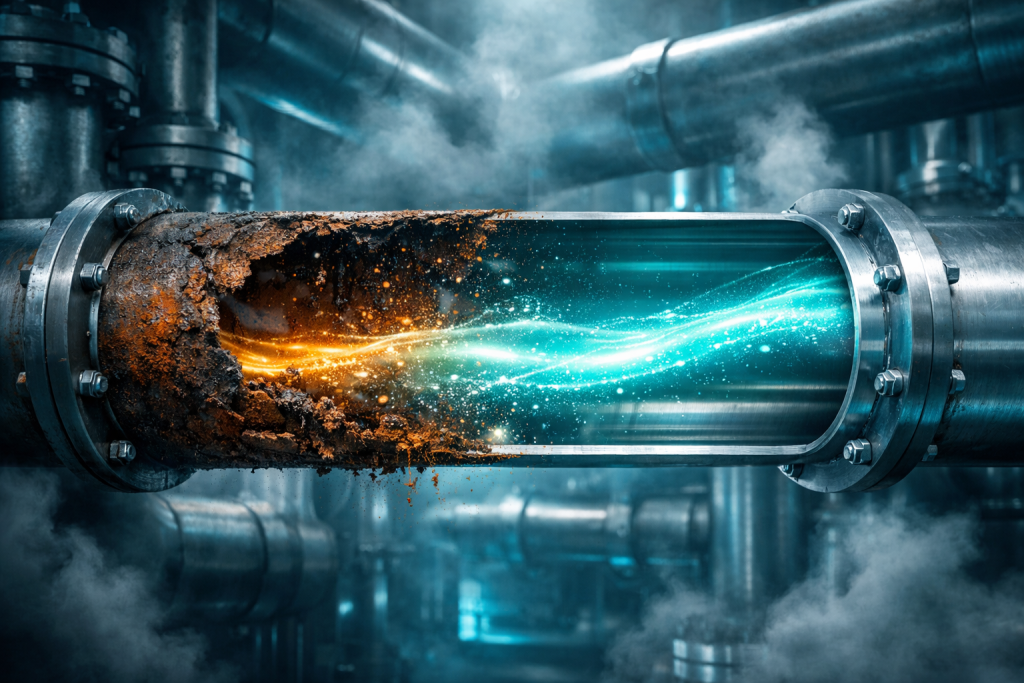
Boiler corrosion is a silent killer. Unlike scale buildup, which announces itself through pressure loss and efficiency decline, oxygen-driven corrosion often proceeds invisibly—pitting steel or iron surfaces from the inside out. An operator can believe the system is clean and healthy while localized corrosion is advancing toward failure. Dissolved oxygen is the culprit in most of these cases. It enters the system through inadequate deaeration of feedwater, through oxygen ingress in condensate return lines, or through poor maintenance of the feedwater deaeration system. Once present, oxygen reacts aggressively with boiler metal surfaces, producing rust and corrosion byproducts that accumulate as sludge and accelerate additional corrosion. The solution is not to fight the symptom—it is to eliminate the cause. Oxygen scavengers chemically react with and consume dissolved oxygen before it ever contacts boiler surfaces, transforming a dangerous corrosive into an inert, harmless product.
01 — The Chemistry of CorrosionWhy Oxygen Attacks Boiler Metals
Boiler corrosion from oxygen is fundamentally an electrochemical process. When dissolved oxygen is present in water in contact with iron or steel, oxygen accepts electrons from the metal surface in a reaction that produces iron oxide (rust) and hydroxide ions. This is oxidation—the same chemical process that rusts a car left in the rain, accelerated by the high temperatures and pressures inside a boiler.
The severity of oxygen corrosion depends on three factors: the amount of dissolved oxygen present, the temperature of the water, and the pH of the environment. Even small amounts of oxygen become dangerous at elevated temperatures. In a boiler operating at 200°F with just 0.5 ppm of dissolved oxygen, the corrosion rate is many times higher than in cold feedwater at the same oxygen level. At boiler operating temperatures (250–300°F and above), dissolved oxygen becomes extraordinarily aggressive.
Consequences of Uncontrolled Oxygen in Boiler Water
The traditional approach to combating oxygen corrosion was mechanical deaeration—using equipment to physically remove dissolved oxygen from feedwater before it enters the boiler. Mechanical deaeration is effective but incomplete; it typically reduces dissolved oxygen to 0.01–0.05 ppm, not zero. Any remaining oxygen is still a threat at boiler temperatures. This is where oxygen scavengers become essential: they remove the last traces of dissolved oxygen that mechanical deaeration cannot reach, providing a complete chemical defense.
02 — Oxygen Scavenger TypesChoosing the Right Chemistry for Your System
Oxygen scavengers fall into three primary categories, each suited to different operating conditions, regulatory environments, and system requirements. Understanding the differences allows you to select the optimal chemistry for your application.
03 — Dosing and MonitoringHow Much Scavenger Is Needed and How to Verify It's Working
Oxygen scavenger dosing is not one-size-fits-all. The correct dose depends on the system's feedwater oxygen load, operating pressure, temperature, and blowdown rate. Underdosing leaves residual oxygen; overdosing is costly and can introduce unwanted chemistry. Proper dosing requires understanding your system's oxygen ingress and monitoring the results.
Calculating Your Oxygen Load
The first step in proper oxygen scavenger dosing is quantifying how much oxygen is entering your feedwater. This depends on:
- Deaerator performance: A properly functioning deaerator reduces dissolved oxygen to 0.005–0.05 ppm. Poor deaerator performance or undersized equipment can result in 0.1–0.5 ppm oxygen in feedwater.
- Condensate return quality: Hot condensate returning from steam lines can re-absorb oxygen if it is exposed to air or passes through vented drains. This is a major source of oxygen ingress in many systems.
- Makeup water quality: Fresh makeup water contains more dissolved oxygen than deaerated condensate. Systems with high makeup water percentages (more than 25–30%) have higher overall oxygen loads.
- Feedwater temperature: Oxygen solubility in water decreases with temperature. Cooler feedwater can dissolve more oxygen; hotter feedwater released less. This affects the total oxygen load reaching the boiler.
Once you know your oxygen load (measured in pounds per day or gallons per day of feedwater × the ppm of dissolved oxygen in that feedwater), you can calculate the scavenger dose needed:
Scavenger Dose (ppm) = (Oxygen Load × 8) ÷ (Boiler Water Volume in Gallons)
This provides a starting point. Add 10–30% excess to ensure all oxygen is scavenged even if feedwater quality fluctuates.
Monitoring and Verification
Once dosed, oxygen scavenger effectiveness is verified through testing. The two most important tests are:
1. Dissolved Oxygen Test (Boiler Water)
Target: Less than 0.05 ppm (ideally <0.02 ppm). Testing frequency: monthly to quarterly. This is the primary indicator of scavenger effectiveness. If dissolved oxygen exceeds 0.1 ppm, increase scavenger dose or investigate deaerator performance.
2. Copper and Iron Levels
Target: Iron <3 ppm, Copper <0.5 ppm. Elevated iron or copper indicates corrosion is occurring. If oxygen levels are low but metal content is rising, investigate alternative corrosion sources (low pH, high conductivity, incompatible chemistry) or increased oxygen ingress that oxygen scavenger cannot keep up with.
CI recommends monthly testing when first establishing oxygen scavenger treatment, then quarterly once the program is stable. More frequent testing is justified if feedwater quality changes (new makeup source, deaerator replacement, condensate system modifications) or if boiler operating conditions change significantly.
04 — CI SP50 Oxygen ScavengerLiquid Sodium Sulfite for Steam Systems
CI SP50 is a liquid sodium sulfite oxygen scavenger formulated specifically for boiler water treatment. It combines the proven chemistry of sodium sulfite with the practical advantages of a liquid formulation, eliminating many of the handling and application challenges associated with powdered scavengers.
Why Liquid vs. Powder?
Traditional powdered sodium sulfite offers effectiveness but introduces operational challenges: undissolved solids can accumulate in feed lines, dust handling creates safety concerns, and dosing accuracy can be difficult. CI SP50 solves these problems.
- No undissolved solids: Complete dissolution means zero risk of line blockage. The product enters the feedwater as a clear solution.
- Precise dosing: Liquid formulation allows for accurate volumetric dosing. Metering pumps can be calibrated to deliver exact ppm levels, reducing waste and ensuring consistent treatment.
- Faster reaction: Dissolved scavenger reacts with oxygen in seconds at boiler temperature. No dissolution delay, no kinetic penalty.
- Better compatibility: CI SP50 is formulated with additives that improve compatibility with other boiler treatment chemicals and prevent unwanted interactions.
- Improved safety: No dust generation. Liquid handling is safer for operators. Storage is straightforward in sealed containers.
- Ideal for food and clean steam systems: The purity and consistency of liquid formulation make CI SP50 suitable for pharmaceutical, food-service, and other applications requiring high-purity steam.
CI SP50 Specifications
- Active Component: Sodium Sulfite (Na₂SO₃)
- Concentration: Approximately 50% active SO₃ (as delivered liquid)
- Appearance: Clear, light yellow liquid
- pH (as supplied): 9–10
- Typical Dosing: 0.5–2 ppm active SO₃ in boiler water, depending on oxygen load and system configuration
- Reaction Time at Boiler Temperature: Complete within 30–60 seconds
- Storage: Cool, dry location. Sealed container to prevent oxidation. Typical shelf life 12–24 months (verify with supplier).
Feeding CI SP50 into Your System
CI SP50 is typically introduced into the boiler feedwater system via a chemical metering pump. The product should be dosed into the deaerated feedwater, ideally between the deaerator outlet and the boiler inlet. This positioning ensures the scavenger has maximum contact time with dissolved oxygen before entering the boiler.
For systems without a metering pump, manual dosing can be performed by adding measured amounts directly to the boiler water during regular blowdown cycles. However, automatic metering is preferable for consistency and safety.
05 — Integration with Total Boiler ChemistryHow Oxygen Scavenging Works with Other Treatments
Oxygen scavengers are one component of a comprehensive boiler water treatment program. They address the oxygen corrosion problem specifically, but other chemical issues require separate treatment. A complete boiler chemistry program includes:
The Complete Boiler Chemistry Framework
- Oxygen Scavenging (CI SP50): Eliminates dissolved oxygen. Prevents pitting and iron oxide sludge formation.
- Alkalinity Control: Maintains proper pH (8.5–11.5 depending on pressure). Prevents acidic corrosion and protects steel surfaces.
- Scale Prevention (Phosphate or Chelant): Binds calcium and magnesium hardness ions, preventing scale formation on heat transfer surfaces.
- Sludge Conditioners: Converts loose sludge into a compact, purgeable form that can be removed through blowdown without accumulating.
- Corrosion Inhibitors (if needed): For systems operating above 300 psi or with aggressive feedwater, additional inhibitors may be warranted.
CI SP50 works synergistically with these treatments. By eliminating dissolved oxygen, CI SP50 prevents corrosion that would otherwise add iron contamination to the boiler water. This iron can interfere with scale inhibitors and make sludge conditioning more difficult. A clean boiler free of corrosion byproducts allows other treatments to work as designed.
Similarly, proper pH control (via alkalinity management) enhances the effectiveness of CI SP50. Oxygen scavenger reaction rates are faster in alkaline environments. Low pH slows the scavenging reaction and allows residual oxygen to persist longer.
06 — TroubleshootingCommon Issues and Solutions
Dissolved Oxygen Remains High Despite Dosing
Likely causes: Deaerator performance is inadequate, or condensate oxygen ingress is higher than anticipated.
Solutions: Increase scavenger dose by 50% (to account for higher oxygen load). Test deaerator outlet dissolved oxygen—if it exceeds 0.05 ppm, deaerator needs maintenance or optimization. Inspect condensate return lines for vents, air leaks, or stagnant zones where oxygen can be reabsorbed. Install check valves or backflow preventers if air is entering during low-demand periods.
Iron Content Rising Despite Low Dissolved Oxygen
Likely cause: Corrosion is occurring from a source other than dissolved oxygen—typically low pH, high conductivity, or incompatible chemistry.
Solutions: Check pH (should be 8.5–11.5 for the system pressure). If pH is low, increase alkalinity. Check total dissolved solids (TDS) and conductivity—if they exceed boiler operating limits, increase blowdown frequency. Verify that all treatment chemicals are compatible and that no incompatible products (high-pH cleaners on aluminum, low-pH acids without neutralization) were recently introduced.
White or Gray Precipitate in Boiler Water
Likely cause: Sodium sulfite residue from over-dosing, or interaction between CI SP50 and another treatment chemical.
Solutions: Reduce dosing to recommended range (0.5–2 ppm active SO₃). Verify that chelant or phosphate treatments are properly dosed—over-dosing scale inhibitor can cause precipitation. Perform blowdown and allow suspended solids to settle, then decant the boiler water. If precipitation persists, consult with a water treatment specialist to verify chemistry compatibility.
07 — ConclusionOxygen Scavenging Is Non-Negotiable
Dissolved oxygen in boiler water is a controllable threat. It is not an inevitable cost of operating a boiler; it is a preventable problem that can be managed through proper water treatment. Oxygen scavengers like CI SP50 provide a simple, cost-effective solution that pays for itself many times over by preventing corrosion damage, extending equipment life, and reducing emergency maintenance.
The operators and facility managers who treat dissolved oxygen as a first-class chemistry issue—not an afterthought—enjoy boiler systems that remain clean, efficient, and reliable. Those who neglect oxygen control accept corrosion as an inevitable cost and deal with the consequences: premature tube failures, reduced heat transfer, contaminated boiler water, and unplanned downtime.
Oxygen scavenging should be part of every boiler water treatment program. CI SP50 liquid sodium sulfite makes implementation straightforward, reliable, and cost-effective.