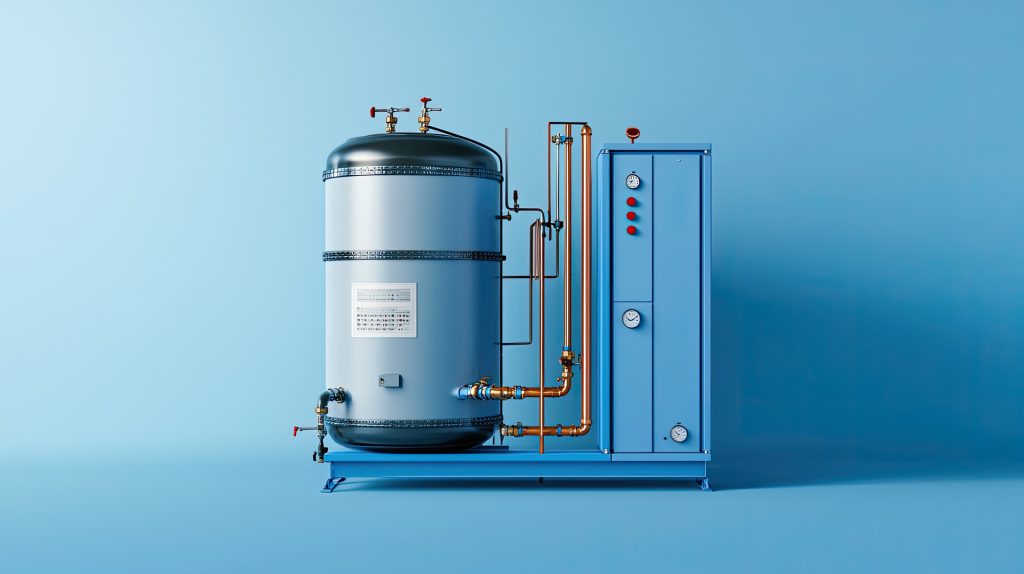
Aluminum has become the standard material in modern high-efficiency boilers because it conducts heat faster, weighs less, and handles thermal cycling better than cast iron or steel. The engineering advantage is real. But aluminum's metallurgical properties also mean it has strict chemical boundaries. Beyond those boundaries, corrosion accelerates silently—pitting the heat exchanger, compromising structural integrity, and leading to failures that replacement parts cannot fully remedy. Many facility operators discover this only when their system begins losing pressure or showing white corrosion staining. By then, the damage is done. Preventing this starts with choosing the right cleaner for initial system commissioning and post-descaling procedures.
01 — The ChemistryWhy Aluminum Reacts Differently Than Steel or Iron
The metals used in boiler construction behave very differently in alkaline solutions. Steel and cast iron are largely inert above pH 10—you can soak them in high-pH boiler degreasers without risk. Aluminum, by contrast, becomes chemically unstable in the same environment. This is not a minor detail; it is a fundamental material property that determines which products are safe to use.
Why pH Matters: The Aluminum Corrosion Window
This narrow window—pH 7 to 8—is why aluminum boilers cannot use conventional boiler degreasers. Most industrial-grade degreasers operate at pH 11 to 13 to achieve maximum cleaning power on greases and oils. That chemistry is toxic to aluminum. The challenge is finding a cleaner that removes oils, greases, and residual boiler compound while staying safely within the aluminum-compatible range.
02 — The ProblemPost-Descaling Chemistry: Acid Residue and Passivation
Aluminum boilers almost always require acidic descaling to remove limescale and mineral deposits left behind during the commissioning fill or accumulated during operation. But acidic descalers are aggressive—they dissolve mineral buildup by attacking it chemically. When the descaling is complete, residual acid remains in the system. If not neutralized properly, that acid continues corroding aluminum surfaces, turning a maintenance procedure into an equipment failure.
The post-descaling procedure is critical. After the acidic descaler is drained and the system is rinsed with fresh water, the next step is to fill the system with CI Neutral Boiler Cleaner at a low concentration (typically 0.5–1% by volume). This serves two purposes: it neutralizes any residual acid still clinging to the aluminum surfaces, and it establishes a protective film on the metal before corrosion inhibitors or antifreeze solutions are introduced.
03 — Solution ChemistryHow Neutral Boiler Cleaners Work
A properly formulated neutral boiler cleaner operates through three mechanisms simultaneously: it removes oils and greases, neutralizes residual acid, and deposits a thin protective film on metal surfaces to prevent corrosion until the boiler is filled with long-term treatment chemistry.
CI Neutral Boiler Cleaner contains surfactants that penetrate and suspend oils, greases, and organic residues without requiring high pH. These surfactants work by surrounding grease particles with charged molecular heads, allowing them to be rinsed away in water.
Mechanism- Surfactants lower water's surface tension
- Penetrate grease layers and lift particles
- Prevent re-deposition of removed oils
- Effective across pH 7–8 range
- Removes machining oils and shop residue
- Cleans light-to-moderate grease buildup
- Works at 1–2% concentration
- Requires 20–45 minutes contact time
The buffering capacity of neutral boiler cleaners ensures they can neutralize residual acid without raising pH above the aluminum safe zone. This is the critical feature that distinguishes them from generic detergents.
Neutralization Process- Alkaline components (carbonates, hydroxides) react with residual H⁺ ions
- Buffering capacity prevents pH overshoot
- Natural pH stabilizes around 7.5–8.0
- Suitable for soft-fill descaling procedures
- Post-acid descaling neutralization
- Systems with high residual chloride (corrosion risk)
- Commissioning fill procedures
- Bridging chemistry before long-term boiler compound
Aluminum's natural defense against corrosion is an oxide layer that forms on the surface. Neutral cleaners contain compounds that strengthen and restore this oxide layer, preparing the system for the introduction of long-term boiler compounds and corrosion inhibitors.
Passivation Mechanism- Silicates and phosphates strengthen the oxide layer
- Creates a micro-scale protective film
- Prevents localized pitting and crevice corrosion
- Stable up to normal operating temperatures
- Most effective with 30–60 minute contact time
- Benefits extend even after solution is drained
- Film remains effective under alkaline boiler chemistry
- Acts as a "protective primer" for long-term treatment
Unlike high-pH degreasers (which attack aluminum) or acidic cleaners (which attack steel), neutral boiler cleaners are compatible with all standard boiler materials because they do not induce corrosion on any of them.
Compatibility Matrix- ✓ Aluminum (3000, 5000, 6000 series)
- ✓ Carbon steel & low-alloy steel
- ✓ Cast iron & ductile iron
- ✓ Copper & brass heat exchanger tubes
- ✓ Stainless steel (all grades)
- ✓ Gaskets and elastomers
- Mixed-metal systems (aluminum + steel sections)
- Composite heat exchangers with multiple alloys
- No need to sequence cleaners for different zones
- Simplifies commissioning procedures
04 — Application ProtocolStep-by-Step Cleaning and Commissioning
The correct procedure for cleaning an aluminum boiler depends on the system's history and condition. New systems require commissioning cleaning; systems being serviced after descaling require post-descaling neutralization. Here is the standard protocol:
New System Commissioning
- Initial fill with CI Neutral Boiler Cleaner (0.5–1% concentration). This removes machining oils, assembly residue, and protective coatings applied by manufacturers.
- Circulate at moderate temperature (140–160°F) for 30–45 minutes. This allows the cleaner to reach all surfaces and begin forming the protective oxide layer.
- Drain completely. Ensure no residual cleaner remains in the lowest points of the system.
- Rinse with fresh, deionized water if possible. At minimum, use softened or filtered water—hard water will immediately deposit new scale.
- Fill with your long-term boiler compound. The protective film left by the neutral cleaner provides a secure base for treatment chemistry to establish.
Post-Descaling Procedure (After Acid Cleaning)
- Drain all acidic descaler completely. Ensure system is emptied to the lowest accessible point. Residual acid in inaccessible zones is the main source of post-descaling corrosion.
- Fill immediately with CI Neutral Boiler Cleaner (1–2% concentration). The higher concentration provides stronger buffering to neutralize residual acid. Do not delay this step.
- Circulate at moderate temperature (120–140°F) for 30–60 minutes. This ensures neutralization chemistry reaches all surfaces, including heat exchanger zones that may still contain acid residue.
- Monitor pH using a calibrated meter if available. Target range is 7.5–8.5. If pH is below 7, circulate longer before proceeding.
- Drain neutral cleaner solution. Collect the drain liquid and check for cloudiness or discoloration—these indicate iron residue or continuing corrosion. High iron content (>5 ppm) suggests incomplete neutralization.
- Final rinse with fresh water or deionized water. This removes any residual ions from the cleaning step.
- Introduce long-term treatment chemistry immediately. Do not leave the system empty or filled with untreated water between cleaning and treatment introduction.
CI Neutral Boiler Cleaner is available in liquid concentrate form for use in this protocol. A typical 5-gallon container treats 500–1000 gallons of system volume at the recommended 0.5–1% dose, providing cost-effective coverage for systems ranging from 5,000 to 50,000 gallons.
05 — Risk AssessmentConsequences of Incorrect Cleaning Chemistry
Choosing the wrong cleaner for aluminum boilers carries real operational consequences. These are not theoretical risks; they occur regularly when facility managers apply "standard" boiler-cleaning practices to aluminum systems without recognizing the material difference.
Specific Risks by Scenario
Long-Term Consequences of Corrosion
Aluminum corrosion in boilers is insidious because it is often invisible until it has caused substantial damage. Early warning signs include:
- Rising iron or aluminum content in the boiler water (detected by lab testing)—indicates corrosion is active
- Pressure loss or difficulty maintaining system pressure—often caused by micro-leaks from corrosion pitting
- Cloudiness or discoloration in the boiler water—suspended corrosion products accumulating
- White or gray staining on heat transfer surfaces—aluminum oxide corrosion byproducts
- Reduced heat transfer efficiency—corrosion deposits interfering with thermal conductivity
- Increased blowdown frequency—TDS (total dissolved solids) rising due to corrosion byproducts
By the time these signs become visible, significant metal loss has already occurred. Prevention through correct cleaning chemistry is far more cost-effective than remediation after corrosion has begun.
06 — Product SelectionSpecifications and Recommendations for Aluminum Boiler Cleaning
CI Neutral Boiler Cleaner is specifically formulated for this application. Its chemistry is optimized to maintain pH in the safe 7.5–8.0 range while delivering effective degreasing and passivation. Here are the key specifications:
- pH: 7.5–8.0 (measured as 1% solution in RO water)
- Alkalinity: 50–100 ppm CaCO₃ equivalent
- Surfactant system: Anionic, non-ionic blend
- Corrosion inhibitors: Silicate and phosphate-based
- Foam suppression: Integrated (prevents air entrainment)
- New system commissioning: 0.5–1% by volume
- Post-descaling neutralization: 1–2% by volume
- Contact time: 30–60 minutes at 120–160°F
- Maximum soak time: 2 hours (no additional benefit beyond this)
- 5-gallon containers (for systems up to 500 gallons)
- 25-gallon drums (for systems up to 2,500 gallons)
- Custom bulk quantities for large facilities
CI Neutral Boiler Cleaner is positioned as the commissioning and post-descaling step in a complete boiler chemistry system. After cleaning and passivation, introduce long-term boiler compound based on your system's water analysis and operational profile.
Typical Workflow- Step 1: CI Neutral Boiler Cleaner (commissioning or post-descaling)
- Step 2: Final rinse with soft/deionized water
- Step 3: Long-term boiler compound (phosphate, chelant, or molybdate-based)
- Step 4: Ongoing testing and treatment balance
- CI Boiler Compound (for long-term protection)
- CI Test Kits (for in-house water analysis)
- CI Technical Support (for protocol questions or custom recommendations)
07 — ConclusionChemistry Is Not Optional—It Is Structural
Aluminum boilers represent a genuine engineering advance: higher efficiency, lower weight, better thermal performance. But they impose a chemical discipline that steel and iron systems do not require. That discipline is not a burden; it is a straightforward protocol that, when followed, ensures equipment longevity and performance.
The cost difference between a neutral-pH cleaner and a high-pH industrial degreaser is minimal—often a few dollars per system. The cost of corrosion-induced failure—equipment replacement, downtime, emergency service calls—runs into thousands. Choosing the right chemistry for aluminum boilers is one of the clearest cases where a small technical decision pays dividends in equipment reliability.
Formulation matters. Commissioning procedure matters. Timing matters. When all three are aligned, aluminum boilers perform as engineered. When any one is overlooked, corrosion follows. The choice is yours to make at the moment of system installation or post-descaling service—and that choice, made correctly, protects your facility's thermal reliability for years to come.
Need Help Specifying Cleaning Chemistry for Your Aluminum Boiler?
Chem International provides technical support for boiler commissioning, water testing, and customized treatment recommendations. Contact our technical team or request a site consultation.
Contact Chem International